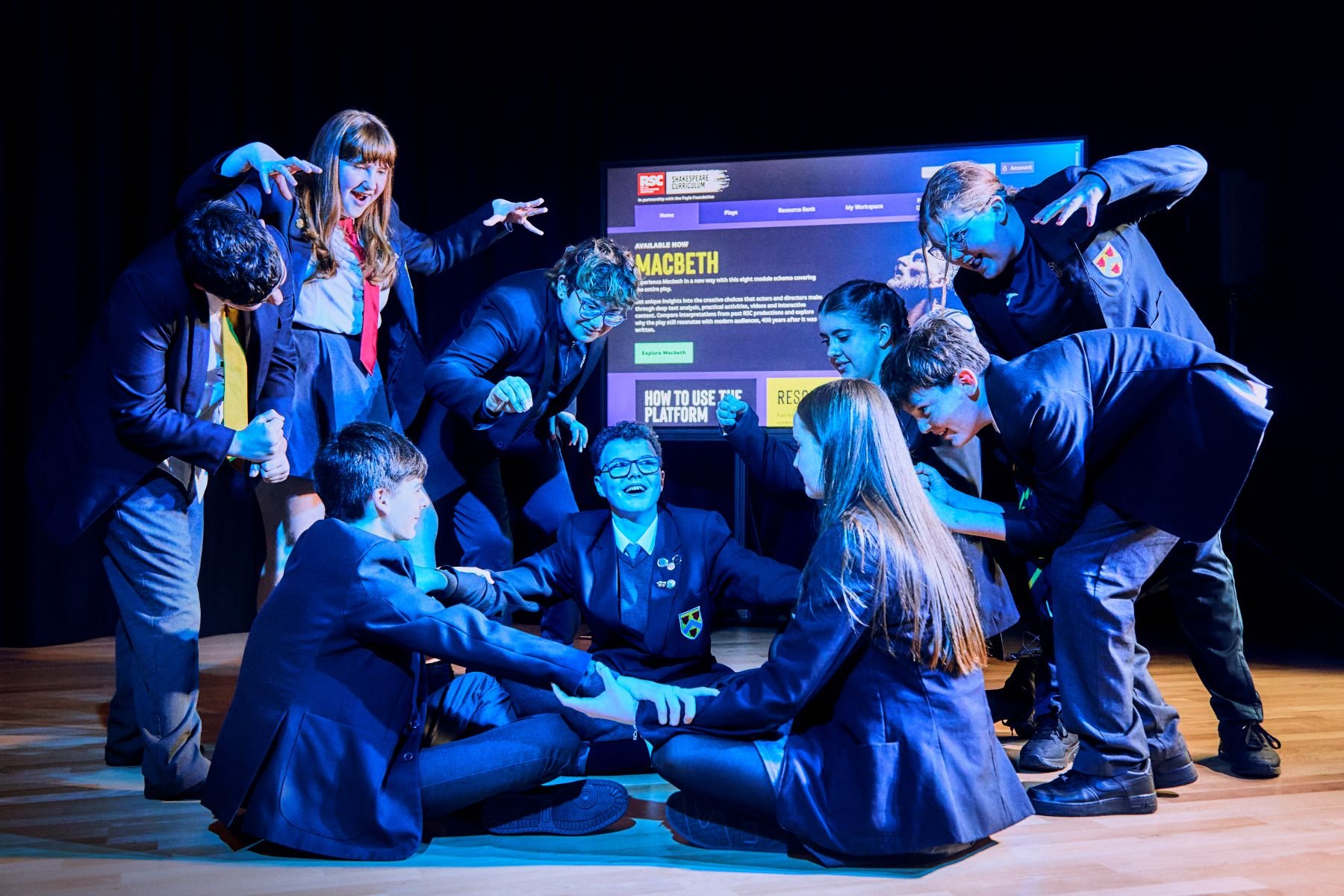
The RSC's Shakespeare Curriculum provides a framework that supports literacy, oracy and social and emotional development
Photo: Ellie Smith
Unlocking the voice: How Shakespeare can transform oracy in schools
The government Curriculum and Assessment Review has been largely welcomed by the arts sector. Here Daniel Evans and Tamara Harvey, co-artistic directors of the RSC, explain how our most enduring playwright can support teachers to deliver new expectations.
The Curriculum and Assessment Review (CAAR), released last November, may stop short of a mandate but its emphasis on oracy and its commitment to “revitalising arts education” are positive steps forward.
At last: an acknowledgement that how children develop socially and emotionally, how they speak, listen and express themselves, is as important as what they know. Our work as a sector is far from done but there are clear green shoots and a genuine sense of opportunity to turn things around.
Reasons for optimism
One of the first proposed changes with real potential to shift the landscape is the end of the English Baccalaureate. It is heartening that the government response to the CAAR went even further, proposing reforms to the Progress 8 framework which would create parity for arts subjects, with arts GCSEs given equal status to humanities and languages.
The government had already announced a National Centre for Arts and Music Education, due to be in operation from September 2026. Although details on the funding and infrastructure to underpin the centre are still to be confirmed, its stated intention is to deliver high-quality arts education for all, including supporting the development of partnerships between arts and cultural organisations and schools.
Another notable result of the CAAR is the commitment to creating new oracy frameworks at both primary and secondary phases of education, to help teachers strengthen their teaching of oracy across the curriculum. Arts learning and oracy-based pedagogies are deeply compatible; opportunities to speak, listen and creatively experiment can all be developed through arts education.
Communicating confidently
The ability to communicate ideas with confidence and clarity is central not only to learning but to life. Employers consistently highlight communication skills as a gap they see in young people entering the workplace and, post-pandemic, speech and language needs remain high.
But teaching oracy and teaching arts subjects effectively requires investment in training and resourcing. Teachers are already stretched and while many deeply value the arts, they often lack the time or training to plan meaningful, sustained arts and oracy-based learning. This is where tried and tested partnership models with organisations already straddling the arts and education worlds can help – and precisely where Shakespeare comes in.
Like all theatres, storytelling and communication sit at the heart of the RSC. We draw on a long history of delivering actor training, of which voice work is an essential part. Shakespeare’s plays offer teachers an endlessly rich source for developing oracy and language skills.
Shakespeare wrote plays for performance. His work is still performed 400 years after it was written not because his plays are printed in books but because they have been spoken out loud and reinterpreted on stage over and over again.
There’s a persistent fear about getting Shakespeare ‘wrong’. But his enduring appeal lies in the fact there isn’t a wrong or right. Rehearsal rooms are places of exploration, discovery and possibility, where actors try things out, fail spectacularly and eventually, together, find a way to tell their story in a way that is relevant for now.
Teachers face a similar challenge: the very best ones are those who open new worlds to their students, allowing them to make their own discoveries.
Active enquiry and listening to educators
That spirit of active enquiry is the ethos behind our rehearsal-based teaching approaches, rooted in the way our actors and creative teams work. It’s a dynamic, inclusive, oracy-based approach to learning that everyone can access.
Combined with Shakespeare’s rich language, it offers an evidence-based way of integrating oracy and creative arts learning in the classroom. Rehearsal-based teaching ignites curiosity, unlocks potential and develops creative agency in students of all ages.
We know exposure to these sorts of experiences is important. But as a sector that has fought for a place at the table for so long, we also need to listen to what the education sector needs. That can mean moving away from short-term engagements towards deeper partnerships with schools: co-creating schemes of work that align with teacher needs, curriculum goals and tangible learning outcomes. For the arts sector to be genuinely supportive, it must operate in a spirit of respect and reciprocity.
For nearly twenty years, we’ve been doing that through our associate schools programme, working in partnership with schools and regional theatres. Our new Shakespeare Curriculum takes this collaborative model even further.
We know our approach works, but we cannot be in every classroom. Developed with and for teachers and young people across the UK, the Shakespeare Curriculum provides a framework that supports literacy, oracy and social and emotional development.
The most meaningful legacy of all
As policymakers consider how to embed oracy across curriculum and assessment frameworks, Shakespeare’s work and the arts have a powerful role to play. The arts are spaces where mistakes can be made and where communication, collaboration and creativity are holistically developed.
Partnerships like ours and others run by arts organisations across the country are examples and invitations: examples of how the arts can support educators to improve learning outcomes and invitations to build deeper, more collaborative partnerships between our sectors.
The future will belong to those who can think critically and creatively, adapt, listen deeply and use language to build understanding. Helping young people find their voices and discover their own form of self-expression is one of the most powerful legacies we can create.
Join the Discussion
You must be logged in to post a comment.