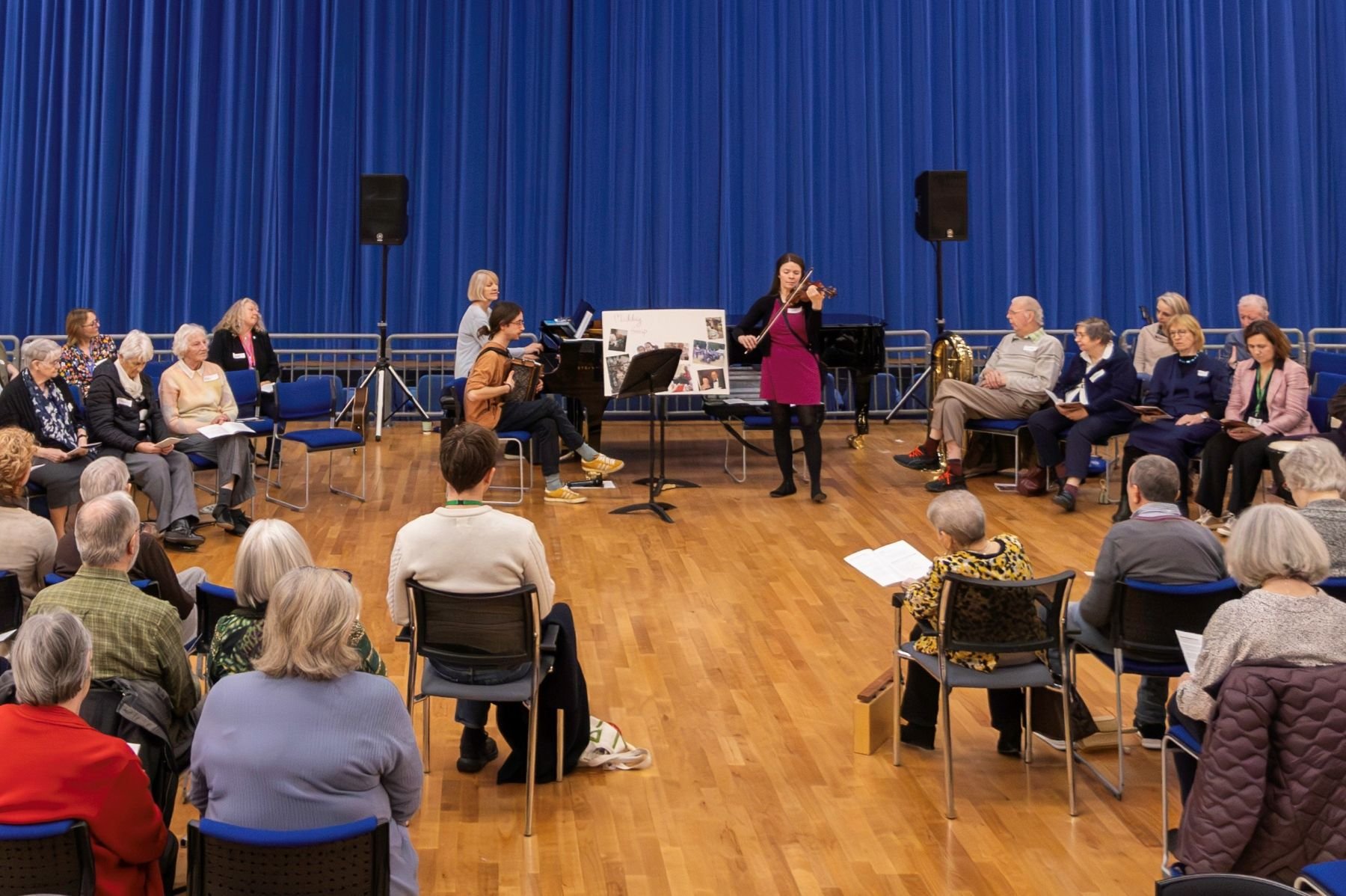
Together in Sound offers free music therapy for people living with dementia and their companions
Photo: Sara Platt/Saffron Hall Trust
Creative health at a crossroads: Why universities matter
The creative health sector sits at the intersection of arts, health and social care, supporting wellness across the UK. Yet this positioning means it often falls between funding systems. Can collaborative work with universities provide any relief? asks Laura Kemp.
There are an estimated 5,000 to 10,000 dedicated creative health practitioners active across the UK, based on sector mapping carried out by the Culture, Health and Wellbeing Alliance (CHWA). This includes artists, facilitators and creative professionals working specifically in roles that connect creativity and health. In addition, there are around 30,000 freelance arts practitioners delivering work that contributes to wellbeing in London alone, and many more across the UK who work in spaces that support the wellbeing of their local communities.
This sector is generous, innovative and growing. It includes work linked to mental health, prevention, social prescribing, community wellbeing and long-term conditions. While the sector has gained increasing policy attention in recent years, it remains structurally underfunded, particularly in relation to the huge demand for its services.
Scarce funding opportunities
Although opportunities are available through Arts Council England project grants, strategic initiatives supported by the National Centre for Creative Health, charitable foundation funding, and some government-backed programmes, most of this funding is short-term, competitive and project-based, with very limited access to sustained investment. Compared with mainstream arts organisations or commercial creative industries, creative health organisations typically operate with far smaller budgets and higher levels of precarity.
Relative to health and social care budgets, investment in creative health remains alarmingly small, even though there is increasing evidence that creative interventions can reduce demand on services and support prevention. Funding rarely transfers directly from NHS or public health budgets into arts delivery, and creative health is often framed as complementary rather than as core health infrastructure.
As a result, the creative health sector sits at a junction where it is highly valued and becoming increasingly visible in policy but remains under-resourced in practice. This is partly due to a lack of evidence to support its efficacy. In this funding landscape, collaboration with universities can be transformative for creative health practitioners and organisations.
Evaluation, evaluation, evaluation.
Academic partners can bring research design, evaluation expertise, ethics approval and credibility. This helps translate creative practice into forms of evidence that health commissioners, policymakers and funders recognise. Robust evaluation can shift work from ‘pilot’ to ‘proven’, strengthening future funding bids.
Dance to Health, developed by Aesop in partnership with researchers at Sheffield Hallam University, Middlesex University and Swansea University, is an example of how a systematic evaluation programme can unlock future funding opportunities. What began as a creative response to the challenge of falls prevention for older adults became one of the most robustly evaluated creative health programmes in the UK. A three‑year evaluation found Dance to Health had significant outcomes, including a 58% reduction in recorded falls, improved activity levels (96%), enhanced mental wellbeing (96%), and increased social connection (87%).
These results provided evidence not only of individual benefit but of system‑level value, with projected annual savings of up to £98m for the NHS. The evaluation was pivotal in securing NHS contracts, Innovate UK and National Lottery funding, and a national profile within health innovation forums. This model has also supported sustainable governance structures, enabling the programme to transition from grant‑funded innovation toward locally-governed delivery models rooted in community dance and health practice.
Another example of the power of evaluation is Together in Sound, a long-running collaborative music therapy programme led by Saffron Hall Trust in partnership with the Cambridge Institute for Music Therapy Research at Anglia Ruskin University. Together in Sound offers free, structured 10-week group music therapy sessions for people living with dementia and their companions.
Established in 2017, the programme was the subject of the lead music therapist’s PhD research as well as being robustly evaluated over the last nine years by its academic partners. Informed by this learning, the partners are now developing a further programme together reaching more widely across Essex.
Co-produced research
The NCACE case study series on Health and Wellbeing features just a few examples of how cross‑sector work can strengthen practice, influence commissioning and contribute to wellbeing at scale. Universities can unlock funding and infrastructure that arts organisations often cannot access alone and improve the likelihood of gaining traction within NHS systems, Integrated Care Boards and public health teams.
Well-designed collaborations improve practice as well as evidence: research is co-produced rather than extractive, supporting reflective practice, ethical frameworks and the refinement of creative health models.
Both the creative health sector and the research sector are driven by a shared belief in curiosity, care and the power of innovation to improve lives. Bringing them into closer dialogue creates space for deeper learning, shared understanding and more sustainable impact.

Join the Discussion
You must be logged in to post a comment.