
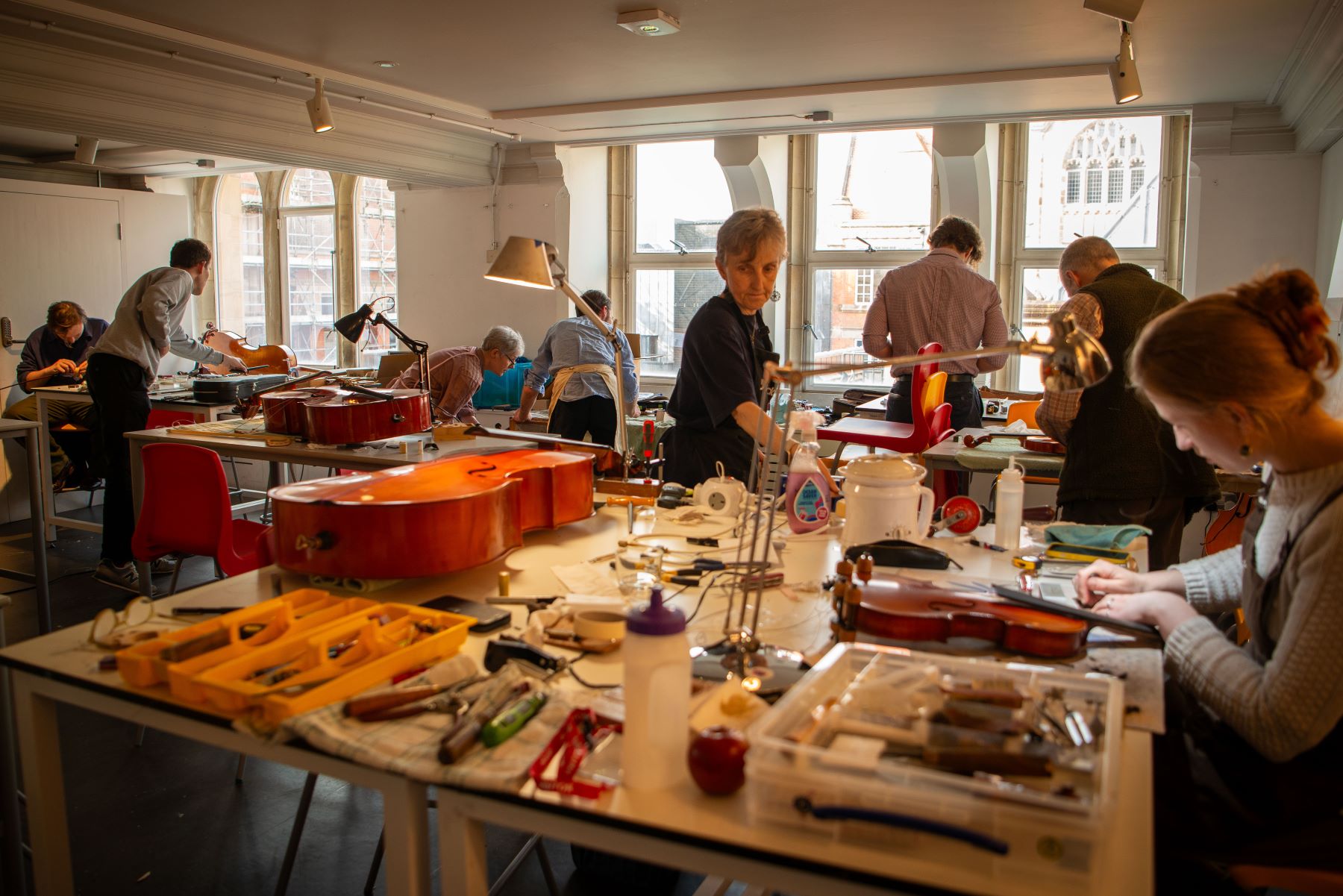
Luthiers working at the Olympias Recycled Orchestra repair workshop at Manchester Museum
Photo: Charlotte Wellings
How a Manchester charity is rethinking music education
Olympias provides free, visionary music education to young people in Greater Manchester. Its CEO Jo Yee Cheung reflects on why music education in the UK needs a radical rethink.
Founded on a shoestring 10 years ago, at Olympias we have carefully developed an innovative model to redefine music education.
We provide musical instruments and sustained access to 1:1 music lessons, challenging the under-representation of global majority cultures in music education and on stage.
And we do it by working within the community. We receive no regular funding and rely on a raft of trusts, foundations and donations from to survive.
Music education in crisis
It is no secret that UK music education is in crisis. The House of Lords has branded the inaccessibility of specialist music education for young people from low-income backgrounds a ‘disgrace’ and a ‘disaster’.
And a bleak report by Arts Council England (ACE) on inclusivity in classical music concluded that, without sustained financial support for music lessons, a child from a low-income background has “virtually no chance of becoming a professional musician”.
But the consequences of a lack of free music education goes far beyond losing out on music lessons. It erodes social mobility and cultural capital, locks out the talents of children born without financial advantage, and guarantees a future where only artists from privileged backgrounds are represented on stage.
Underpinned by core principles
Since 2015, Olympias has delivered 38,000+ free music lessons to more than 600 children who have participated in our programmes. Our unique model is underpinned by core principles:
- Sustained, pupil-centred learning in a 1-to-1 setting outside school
- Access to an instrument which can be taken home
- Regular contact between teachers and parents
- Wraparound choirs, orchestras and performances
While this might sound like a traditional approach, what’s radical is offering this freely to young people at financial disadvantage over many years, irrespective of whether they wish to pursue a musical career.
We started with eight participants and now have 180, with 400 more attending choirs, orchestras and SEND workshops weekly.
Continues…

Photo: Charlotte Wellings
Journey of discovery
The last decade has been a journey of discovery with a bold move away from working with schools. This created a financial burden of paying for premises, but had the advantage of ensuring direct relationships with parents of those children who choose to participate.
Some of Olympias children have played for Yo-Yo Ma; performed in a 250-person opera at Manchester International Festival; and have experienced music lessons in the mountains at our week-long residential course in Snowdonia.
This might sound utopian at a time of financial precarity, but we firmly believe our model offers great value for money. We create stable employment for freelancers, at the same time as nurturing a pipeline of global majority musical talent and creating future generations of happy, connected and musically-engaged adults.
For example, Savana (16) lives with her single mum and dreams of a career in the West End. Despite struggling at school, she has always used music as a creative outlet, receiving free singing lessons through Olympias. In September, she was accepted into Pendleton School of Musical Theatre: “I couldn’t have done it without you, you gave me the confidence.”
Azra (11), originally from Turkey, says: “Playing in concerts has helped me build the confidence to play music in front of people. Performing makes me relaxed and proud. When I play at Olympias events, I feel like we’re a very professional group of people.”
Chronic short-termism
The arts funding crisis has led to chronic short-termism in dealing with problems such as underpayment of music teachers, landfilling of cheap instruments and tokenistic attempts to increase representation through diversity quotas. The ‘solutions’ offered are often a false economy that costs more in the long run. Lasting change requires a structural answer.
At Olympias, we pay the Musicians’ Union rates, enabling better retention and sustained pupil engagement and progress. We also offer a one-year Global Music Teacher Training programme for exceptional global majority musicians to become professional teachers, who go on to share their heritage with Olympias children.
In partnership with the Royal Northern College of Music, we are supporting a PhD student to assess project outcomes and share best practice. And this year, with the help of local instrument makers and the public, we launched our Recycled Orchestra, repairing instruments destined for landfill and providing them freely to young musicians.
Such creativity and passion beget collaboration and generosity. Vision and values first, budget and funding later.
Essential ingredients
So, what have we learnt from ten years of Olympias? Here are five essential ingredients for a radical and visionary music education for all:
- Prioritise sustained programmes, rather than one-off projects
Structural change takes time and consistency. Decision makers should be mindful of tokenism and support existing programmes that deliver long-term change, rather than pushing constantly for new initiatives.
- Pay music teachers good wages
Fair pay = staff retention = pupil retention = long-term impact.
- Focus on quality of experience over quantity of children
Some activities work brilliantly in a group, but a one-off 20-minute group trombone lesson for 30 kids doesn’t do much more than tick a box.
- Get the parents involved
Parental engagement is essential to shaping attitudes and a love of music. How music is experienced in communities can be more important than what happens in lessons. This develops organically when lessons are held outside school.
- Start small, build roots and keep it local
Olympias works because it addresses the hopes, dreams and challenges of our community in inner-city Manchester. Build trust with the people you serve, take small but ambitious steps towards the change they want to see.
Every tree begins as a seed.
Join the Discussion
You must be logged in to post a comment.