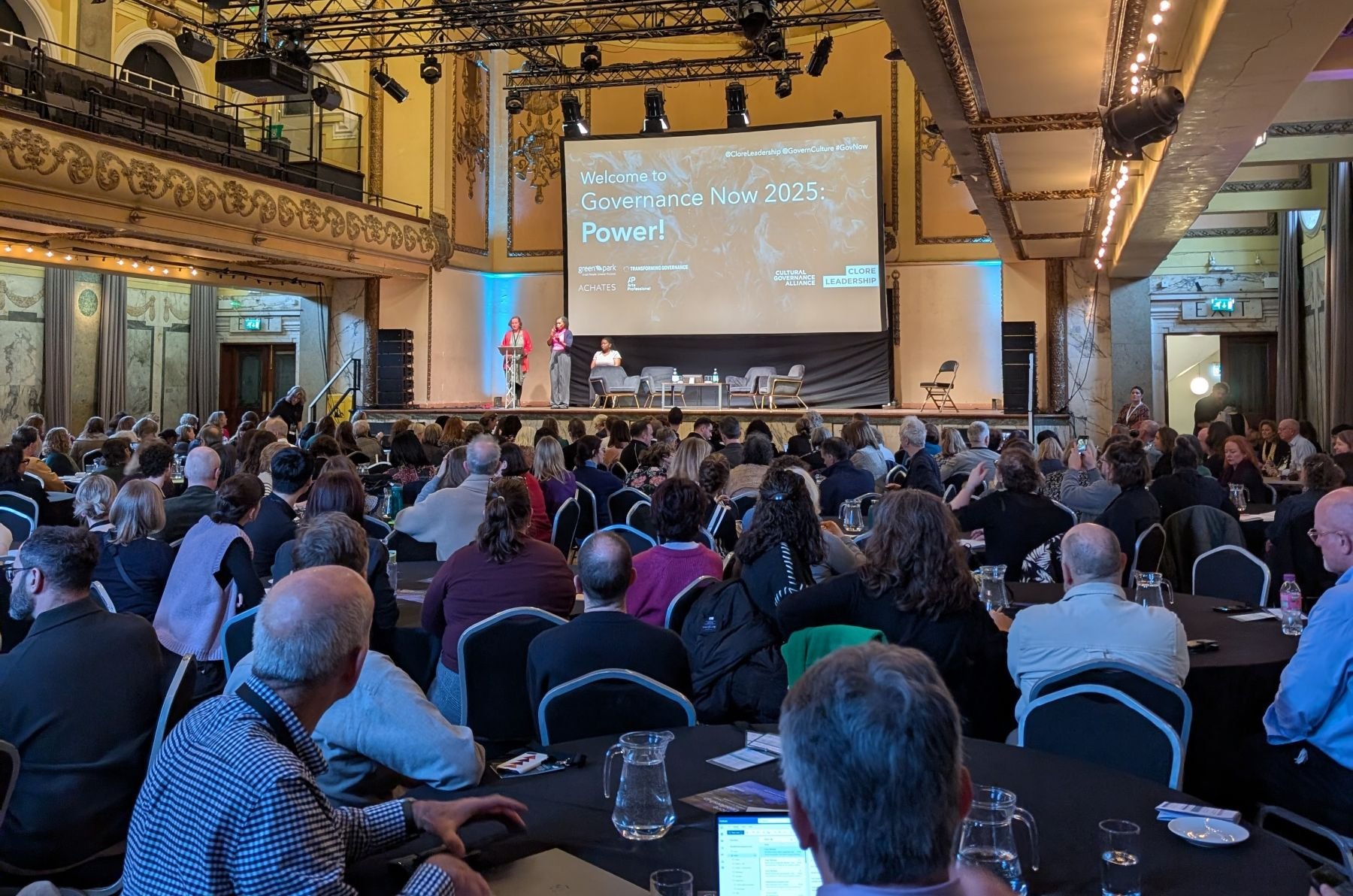
This year's Governance Now conference explored how power is held, how it is shared and how that impacts creative and cultural practice
Photo: Clore Leadership
The power of conversation
Reflecting on this year’s Governance Now conference, held during the first week of November, Clore Leadership’s Rebecca Usher was struck by the power of conversation to connect and imagine new possibilities.
“Governance is not just policy and compliance. It’s a human practice shaped by the biology of connection, the psychology of trust, and the politics of power.” The words of Suzanne Alleyne, founder of Alleyne&, to delegates at this year’s Governance Now conference, where power was the central theme.
Power shapes culture – and culture shapes power. Throughout the day, with a brilliant line-up of speakers, we explored how power is held, how it is shared and how that impacts creative and cultural practice.
Alleyne talks about “the power of connection” and, as we gathered over 300 cultural leaders, what struck me most was the sheer power of conversation itself. From the lively exchanges between sessions to the thoughtful reflections in the online chat, it was clear conversation remains one of the most vital tools we have as leaders.
Through conversation, we connect, test ideas, find solidarity and imagine new possibilities together.
The power of partnership
Since Covid, opportunities for informal discussion have reduced, placing even more value on these spaces for genuine connection. In a fast-changing sector, these conversations play a strategic role, helping leaders share intelligence, spot emerging patterns and strengthen the networks that support organisational resilience.
For leaders navigating increasingly complex and uncertain times, these conversations act as grounding points, helping us to sense-make, reflect and stay human in the midst of challenge. I overheard many conversations where leaders were swapping emails or numbers with promises of “we should work together” or “let’s make this happen.”
In the closing panel discussion, Power, Policy and Partnerships, Kate Varah, co-CEO and executive director at the National Theatre, spoke about the power of partnerships – how we ensure partnerships work to the benefit not just of the organisations involved, but the broader cultural landscape.
Collaboration, she reminded us, is both an art and a necessity. When partnerships are built on mutual respect and a shared purpose, they become catalysts for innovation, resilience and change. The power of collaboration lies in its ability to distribute leadership.
The power of diversity
In a sector balancing creativity with complexity, conversations give us space to think collectively. They sharpen our intelligence, challenge assumptions and help us navigate the nuance of leading people, organisations and movements. Whether we’re discussing governance, equity, funding or vision, our ability to listen and respond with curiosity shapes the quality of our leadership.
And this is where diversity of voices becomes a superpower. Across breakout sessions, several discussions tackled the length of trustees’ terms of office. Should valued trustees serve multiple terms to preserve stability and expertise, or should bringing in fresh voices to keep organisations relevant and agile be prioritised?
Both approaches have advantages, but each shift creates a transitional moment that requires care and attention. What emerged was not a definitive answer, but a collective recognition that balance and intention are key. The most effective boards – and indeed, leadership teams – are those that understand when continuity serves and when change is necessary.
The exchange of perspectives feeds into something bigger: our shared voice as a sector. Every dialogue, formal or informal, contributes to a deeper understanding of the cultural landscape. They help us articulate the needs, ambitions and values that underpin great leadership of culture. When we bring those voices together, advocacy becomes stronger, more authentic and more grounded in lived experience.
The power of advocacy
Advocacy was a key intervention for change in Clore Leadership’s Imagine It Different report, part of our World of Work series. Our partners at the Arts Marketing Association have been leading on this strand of work, bringing together 30 sector support organisations to explore the challenges of advocacy and how we can unite with a shared, collective voice. We look forward to sharing more on this later this year.
With a collective voice, we have influence and agency – nothing illustrates this more clearly than the recent publication of the Curriculum and Assessment Review with the removal of the EBacc performance measures.
Jenny Waldman, director of Art Fund and one of the conference speakers, noted that Art Fund had “highlighted the importance of cultural access for early years children” among its priorities when addressing the Labour Party Conference in September.
It’s a powerful example of what happens when we align around shared purpose: our sector’s united voice carries weight with policymakers and government.
The power of curiosity
Leadership isn’t only about action; it’s also about listening, questioning and staying open to what emerges in dialogue. Conversations connect us, and they remind us that leadership is a shared practice.
One quality underpins this kind of leadership: curiosity – the willingness to stay with questions, even the uncomfortable ones. When we approach difference with curiosity rather than defensiveness, we unlock new ways of thinking and open ourselves to perspectives that can shift systems.
As Suzanne Alleyne said in her closing remarks: “The world around us is uncertain. Systems are strained. But in this room, today, you have agency. You have influence. You have power.”
And that’s the real takeaway: power is not something to hold tightly or guard, but something to share, through conversation, connection and collective action.

Join the Discussion
You must be logged in to post a comment.