
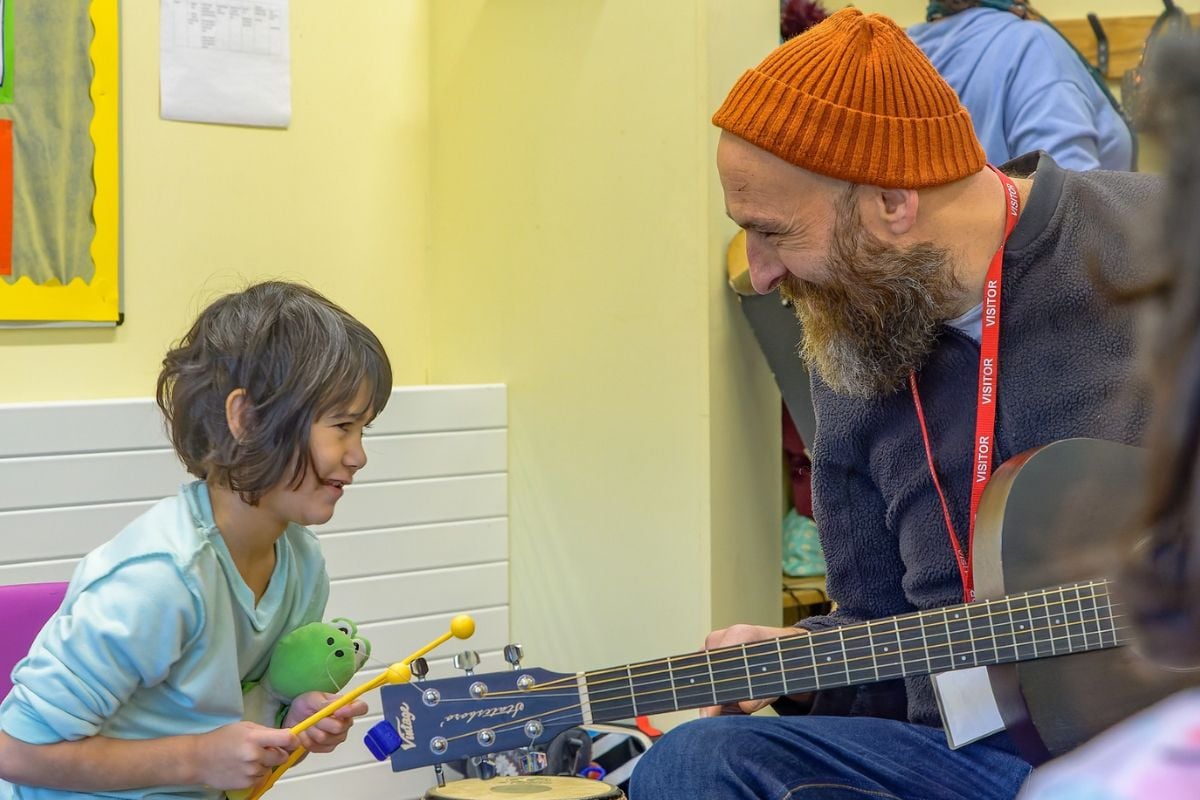
A three-year pilot scheme took a 'pupil-led approach' to embedding music into Autism Resource Bases
Photo: Live Music Now
Pupil-led creativity: Researching the power of music in the lives of autistic children
Artist Alex Lupo, music in education leader Karen Irwin, and researcher Beth Pickard discuss the transformative importance of music in the UK’s specialist units for autistic young people.
Every child deserves access to meaningful, high-quality music making. When we set out on our research project — a collaboration between Live Music Now and the University of South Wales — our aim was to widen access to music in Autism Resource Bases (ARBs) across the UK.
Music can strengthen social, emotional and learning outcomes for all pupils, including autistic pupils. With the number of ARBs in mainstream schools rising exponentially, and anecdotal evidence from pilot work showing music provision remains limited in these spaces, widening access is a social justice issue.
Music is vital for all children, but research shows it can be especially transformative for young autistic people, around one in 20 of whom show exceptional musical ability alongside other developmental differences.
This research was co-produced with autistic people throughout and informed by their lived experience. It was guided by the Social Model of Disability, which recognises that barriers are most often created by environments and systems, rather than individuals themselves.
Foregrounding creativity
Between 2022 and 2025, Live Music Now worked with Music Education Hubs in Somerset, Liverpool and Harrow to deliver music in 24 ARBs, engaging more than 340 young people. We took a flexible, pupil-led approach that foregrounded creativity. Our approach was shaped by learners’ interests and preferences, leaving ample room for creative exploration.
During the three-year pilot we observed that children’s creative music skills, ability to take turns and collective attention developed noticeably. We also observed improvements to children’s agency and control. Staff confidence also measurably increased as adults became more comfortable adapting lessons and using music as a form of communication.
Pupils used music to express emotions, connect with others and self-regulate. Wider benefits included the development of a set of resources to support musicians and other staff to take a more confident approach to flexible, creative pupil-centred music-making.
Centring lived experience within research
Building on this rich pilot work, we were excited to be awarded funding from the AHRC Hub for Public Engagement with Music Research at the University of Southampton to develop a research project. Prior to progressing our work to engage autistic learners in music education, we’ve devised a separate 12-month research process to deepen our understanding of the context of what we are setting out to do, and to develop further strategy in collaboration with autistic people and policy makers.
We’ve recruited a steering group of autistic musicians with a rich variety of lived experiences to collaborate with us, in our goal to centre autistic perspectives. The first phase of the project is now behind us. It included a scoping review highlighting the absence of research on this topic in the UK, confirming the gap our research will fill. The literature emphasised teachers’ perspectives, affirming the importance of our intention to foreground autistic children and young people’s experiences and responses in our research.
Meanwhile, an online survey targeting ARBs (and their regional equivalents) received more than 100 responses from all four UK nations. Despite the fact ARB staff members’ confidence in delivering music was low in the pilot work, the survey reveals a more mixed picture. Respondents reported barriers to accessing music, including limited “resources”, “budget” and “expertise”.
The survey shows that most music provision in ARBs were delivered by ARB staff, with only a third of settings having any engagement with their local music education hubs or music services. A clear opportunity exists to facilitate closer engagement between music education hubs and music services and ARBs.
What meaningful engagement looks like
The second phase of the project is ongoing, including a series of focus groups with colleagues involved in the pilot work and a range of professional stakeholders from the education sector, music industry, and autism specialists: as many of whom have lived experience as possible. In addition, we’ll work with autistic children and young people with learning disabilities to understand what meaningful musical engagement means, looks and sounds like to them. This will inform how we move into our next, and third, phase: delivering two 10-week musician-in-residence projects at ARB in South Wales and Northern Ireland.
Our final phase will conclude with the development of an open-access resource, signposting existing best practices and advocating for accessible opportunities to engaging more learners with music.
Ever more timely, ever more important
We believe that every child and young person deserves high-quality music education. Music has the potential to enhance social, emotional and academic outcomes for all children, in myriad and significant ways, but for autistic children in particular. As the number of ARBs within mainstream schools grows rapidly across all nations of the UK, this focus becomes increasingly timely and important.
Join the Discussion
You must be logged in to post a comment.