
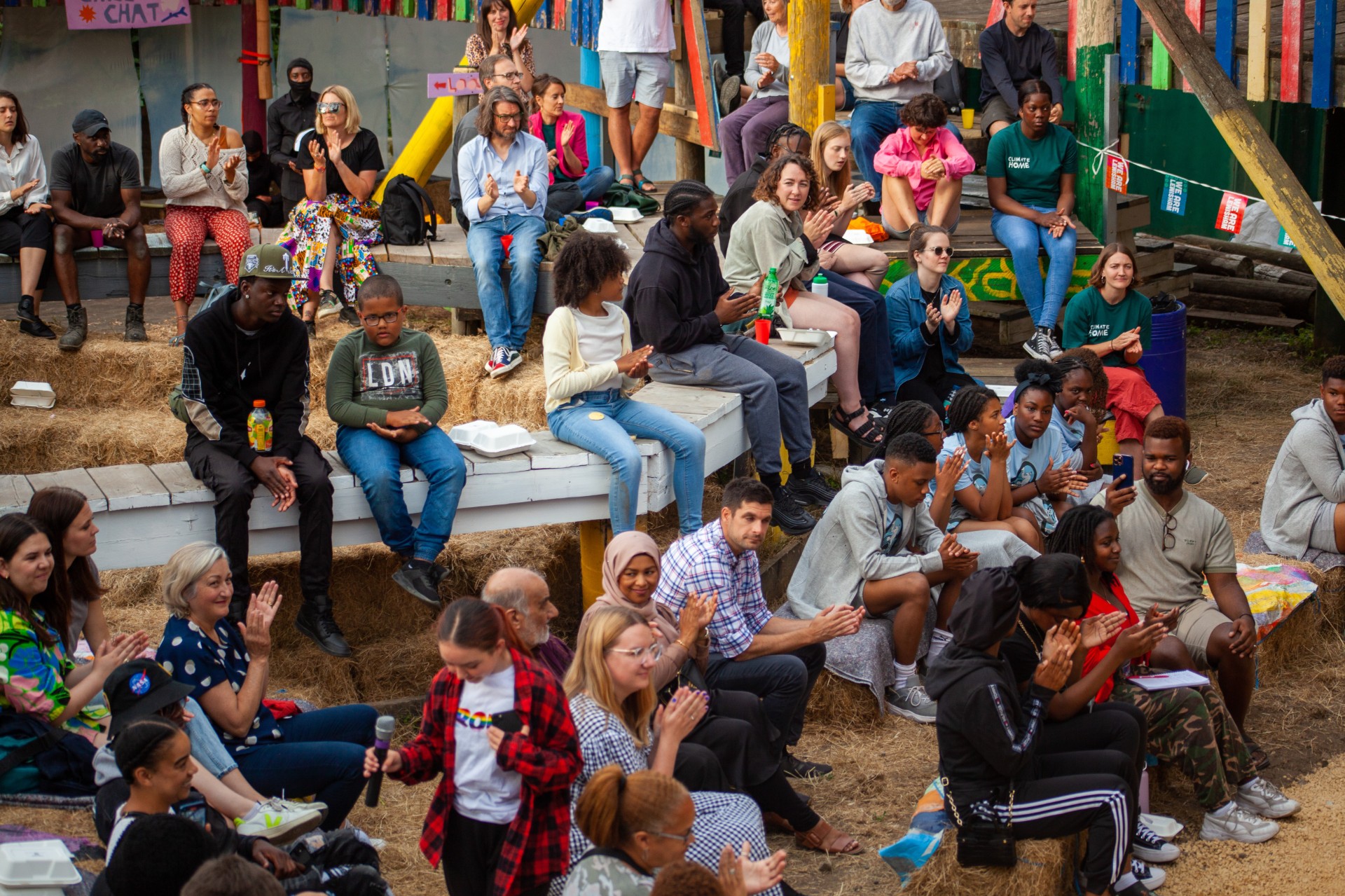
Climate Home presented by the Albany and Sounds Like Chaos as part of We Are Lewisham, London Borough of Culture 2022
Photo: Ines Yearwood-Sanchez
Local engagement, national conversation
In an era of political division, it’s more important than ever to build collaborative networks that link the local to a wider context, according to Michael Eades of Goldsmiths University of London.
We all know what ‘local’ means to us. Geographically, it means the area where we live, work and spend time. It means our street, our neighbours, where we shop, the parks and green spaces we visit, the cafes, restaurants, pubs and bars we spend time in, the cultural or sporting venues we go to.
Civic institutions – local authorities, health and education services, volunteer groups, universities, arts and cultural organisations – provide the glue that hold it all together. Everyone’s ‘local’ is a bit different, but we all care about the places, people, communities and issues that are geographically close.
But should we stop there?
Local institutions, national networks
In an era of political division, it’s more important than ever to build collaborative networks that link the local to a wider context, to explore how your ‘local’ connects to the contexts experienced by people across a wider geography. In short, to think about to connect ‘local civic’ to ‘national civic’.
At my own institution – Goldsmiths, University of London – our local civic context is southeast London. More specifically, it is the London Borough of Lewisham – a vibrant, multicultural area. Its civic context makes it both distinctive and connects it with other areas and communities.
Proudly independent, creative and free-thinking, our area is a creative and cultural hotbed, home to many creative businesses, individuals and institutions – many of whom have links to the creative incubator that is Goldsmiths.
Lewisham was London Borough of Culture in 2022 and the UK’s first ever Borough of Sanctuary in 2021 reflecting its long and enduring status as an area of high migration and cultural diversity. It is a place Goldsmiths is very proud to call home.
While celebrating our unique culture, we mustn’t lose sight of what we have in common with other places. One thing, sadly, is poverty. According to the government’s indices of deprivation, Lewisham – with a population of more than 300,000 – is ranked 63rd most deprived local authority in England and 51st most income deprived, behind Doncaster at 48, County Durham at 49 and Stockton-on-Tees at 51.
While caring deeply about the issues that affect us locally, we should not lose sight of the fact that many of the challenges – and opportunities – we face are in common with people across the country. Local conversations are always also national ones.
Cross-sector collaboration
This is why we have paired with Future Arts Centres (FAC) – a network of more than 170 arts centres across the UK, a collaboration which started locally. As a university, we have a longstanding and very successful partnership with the local Albany arts centre, which is a founding member of the FAC Network.
Arts centres, like universities, are places where new ideas and new ways of seeing the world are explored. They are spaces of knowledge, innovation and encounter. As Annabel Turpin and Gavin Barlow, co-directors of Future Arts Centres, observe, arts centres are rooted in their local communities in ways that make them unusually responsive and flexible.
Their strength lies in being led by people and relationships rather than artforms, acting as anchor organisations that bring diverse communities together and ignite a ‘collective imagination’ – an essential foundation for rethinking and revitalising local democracy.
Creative democracy: our line of enquiry
The collaboration between Goldsmiths and the Albany launches with what we are calling ‘a line of enquiry’ focused on exploring the concept of ‘creative democracy’. By which, at the fundamental level, we mean the capacity of the arts in general, and arts centres specifically, to act as a bridge between local communities and the machinery of democracy – particularly local government.
We want to explore the role arts centres can play as ‘creative town halls’ where complex social issues – climate change, housing, migration – can be explored and debated. To explore how arts centres can act as neutral, inclusive and trusted spaces for these conversations to happen. We want to explore how artists, creative practitioners and researchers can help policy makers think around corners and have a better dialogue with their local communities.
In the first instance, we will pursue this line of enquiry via student placements with Future Arts Centres. Goldsmiths students will undertake research linked to and complementing their studies, spending time with the FAC co-directors, speaking to representatives from the network and attending meetings.
Their research will feed into an industry round table, hosted at Goldsmiths, that will bring together representatives from the FAC network and others to explore what creative democracy. We expect our line of enquiry to grow and expand and to form the basis for a more ambitious research collaboration to make a positive impact in a world of polarised political debate.
In increasingly uncertain times, we need to pull off the challenge of concentrating both on improving the lives of the people immediately around us, making our local areas better and happier places for people to spend time, and also connecting this to a broader political context.
We need to start building a national network of local creative conversations – each unique but linked by common threads. We need to think creatively about how to work directly with communities in rebuilding trust in public institutions, create more positive spaces for public debate, and reconnect with the creativity and common values that connect us.
We hope our local/national civic collaboration will demonstrate one way of doing this. In the current political climate, it is more important than ever that we try.

Join the Discussion
You must be logged in to post a comment.