
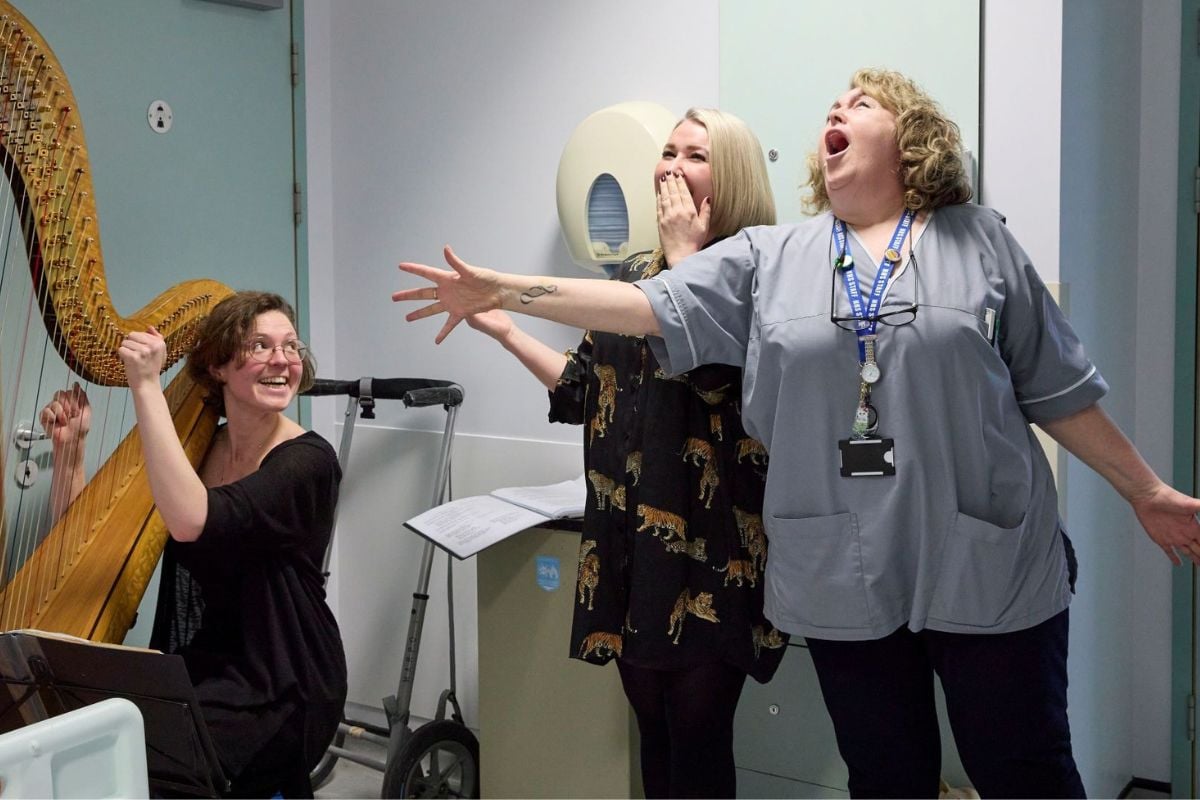
Live Music Now in a workshop at Royal Brompton Hospital
Photo: Isabelle Marshall
Creative health, collaboration, and practice
Conni Rosewarne and Mary Paterson both work to integrate art into healthcare settings. Here, they discuss the unique problems facing creative health as a sector, the potential it offers for positive change, and the ways in which it can learn from the wider arts landscape.
Mary Paterson: I’ve been surprised at how difficult the transition has been, coming from the charitable arts sector to work in-house as an arts manager in the NHS. Despite a growing interest in and understanding of creative health, the NHS is a difficult place to embed creative practices and principles.
Conni Rosewarne: We need to raise awareness around artistic labour and value, which is often misunderstood within NHS systems. NHS decision makers are, naturally, led by data and managing budgetary concerns, often in the context of having to make urgent decisions, especially amid government reforms.
MP: One thing I often get asked when programming art in hospitals is whether artists need to get paid at all! We are working in a context of real and perceived scarcity and competition.
CR: Yes, and this doesn’t just affect how much money is available, but also which kinds of decisions feel possible. A major challenge in convincing decision-makers to fund creative health is that they are under pressure to avoid spending money on things which are not publicly perceived as urgent front-line needs for an NHS in crisis.
Collaborative methods
MP: My experience working in the charity sector is that there has been a conscious drive towards collaboration and solidarity. For example, organisations like Arts Emergency or London Arts and Health name the problem (lack of diversity in the arts), and recruit volunteers from within the sector to solve it together.
It is difficult to simulate that structural solidarity in the context of hospital arts, because each hospital arts team is a small group of people working inside a large NHS trust, and each trust has its own institutional practices. Arts teams are funded in different ways inside different trusts, resourced differently, and managed by different parts of the organisation.
Why do you think this is? Is there a natural conflict between the scale of an institution when it gets to the size of an NHS trust or an Integrated Care Board (ICB), and the notion of community? Or do you think the problem is ideological?
CR: Scale certainly plays a role, but there is a fundamental conflict, too: we are always being put on priority lists. I have conversations with NHS colleagues who champion creative health but must ask, ‘how do we make the case in a way that the NHS will understand?’ A common fear is that to put money into an arts project, they may have to take money out of something else.
MP: This means we are often pitted against our colleagues and partners within the system. It takes an emotional toll on us all, and runs counter to the collaborative relationships needed for art to thrive.
Starting small but strong
CR: I think it’s crucial to hold on to the idea that starting small but strong can yield a big impact. I saw this in the NHS North East London ICB collaboration with Cardboard Citizens, a theatre company working with people who have experienced homelessness.
Members of Cardboard Citizens worked with homeless health professionals to co-design the ICB’s homeless health strategy through a half-day theatre workshop. By handing this process over to an artist-facilitator and working with members via creative practice, it levelled power dynamics and avoided tokenism.
Relationships and hierarchy
MP: This is exactly what makes art so accessible and so important. At the recent National Arts in Hospitals (NAHN) conference in York[1], the researcher François Matarasso explained why he refers to ‘professional artists’ and ‘non-professional artists’ in community arts, rather than ‘artists’ and ‘participants’. It’s a way of acknowledging the skills everybody brings.
At Royal Brompton Hospital, we co-designed a mural for the main entrance to the building, in six creative workshops with patients and staff. The real success of the project, for me, is how the workshops created a space linked to the hospital community but separate to it.
On the first day, some members of staff told us they didn’t want anyone to know they worked for the NHS; they were wary of invoking the staff-patient dynamic. By the end of the project, these fears had disappeared – new relationships were possible.
Routes between institutions and arts hubs
CR: Navigating clinical spaces is a nuanced practice that requires appropriate training, management, and supervision to safeguard practitioners and participants.[2] Practitioners must balance fostering creative imagination within emotionally charged, institutional spaces.
It highlights the need for referral routes from hospitals to arts spaces that support creative health. The music venue Hoxton Hall is currently exploring this relationship with St Leonard’s Hospital, offering space to groups of people living with severe respiratory diseases to meet and access their creative health programming.
MP: In my role, which is embedded inside hospitals, I wonder how I can learn from the ways in which arts organisations are radically addressing their power dynamics. When I was chair of the disabled-led theatre company Extant, we worked hard to imagine leadership models which do not rely on one individual. Now even organisations the scale of the National Gallery are involving audience members in key decision-making.
CR: It is really exciting to see this cultural democracy in action. Imagine personalised care as a curatorial practice, or vice versa. It could challenge who creativity and healthcare belongs to; perhaps this will also shift how decisions are made, and by whom?
[1] 18th – 19th October 2025, organised for NAHN by York and Scarborough Teaching Hospital NHS Foundation Trust
[2] See for example Nicola Naismith’s research in Naismith, N. 2021. Practising well: conversations and support menu. Aberdeen: Robert Gordon University [online]. Available here.
Join the Discussion
You must be logged in to post a comment.