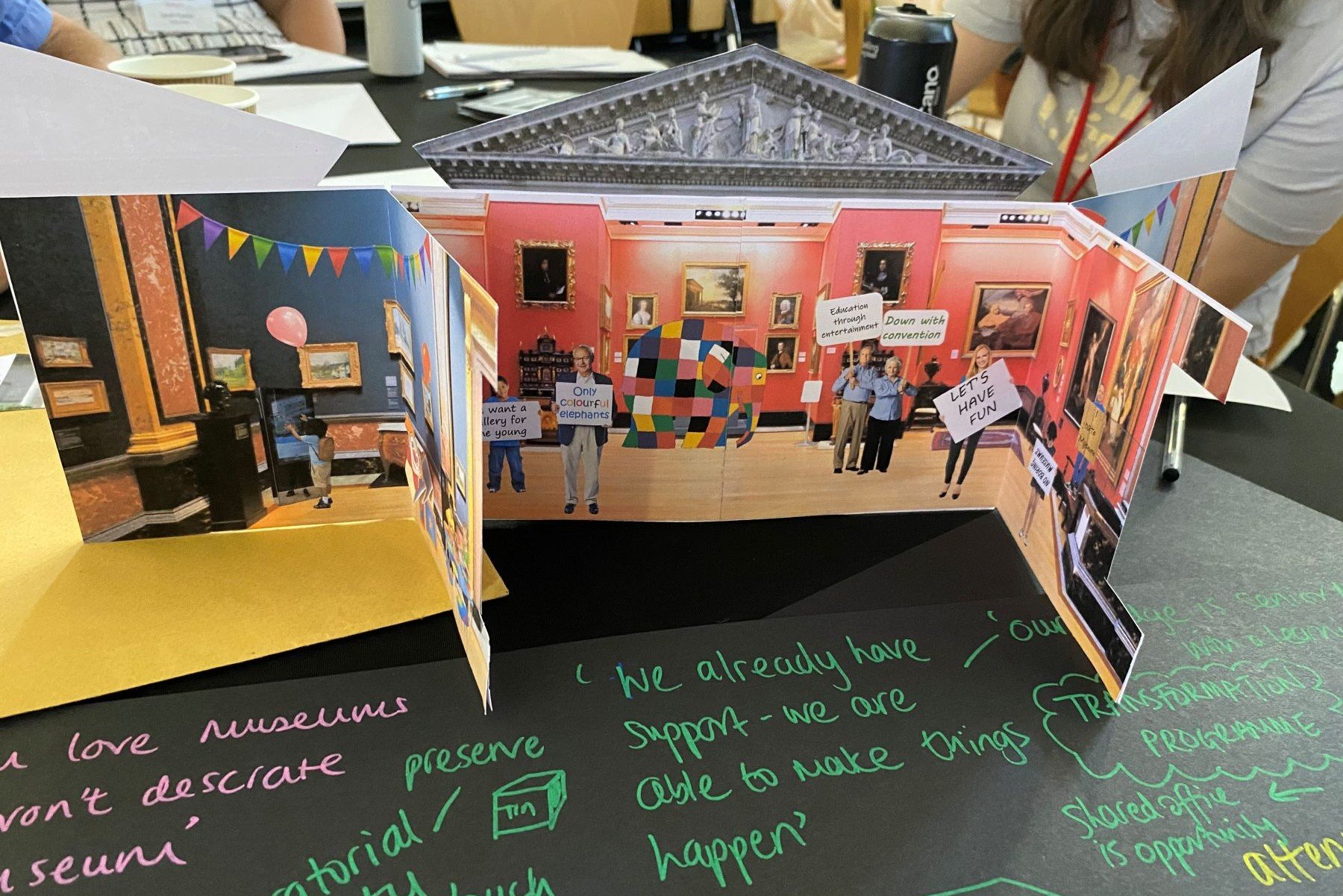
A museum model made by participants at a workshop for museum professionals led by Tim
Photo: The Fitzwilliam Museum
Creating belonging: Museums as spaces for community knowledge-making
The Fitzwilliam Museum in Cambridge is pioneering a radical and potentially transformative approach to museum-based research and programming, as Kate Noble explains.
When Tim, a community member, declares that he “hates museums”, he’s not being provocative – he’s articulating something profound about institutional change. “I mean that I want them to change” he explains, showing a 3D model he has made at home to demonstrate how he envisions museums could “open up and come to life”.
This isn’t the voice of a disgruntled visitor, but of a co-researcher whose insights are shaping how one of Britain’s most prestigious university museums operates. “We have a responsibility to the residents of Cambridge” says another co-researcher, challenging the museum to become “an amazing part of the community”.
Transformative approach
Over the last four years we have been developing a radical and potentially transformative approach to museum-based research and programming. Rather than simply consulting local communities about pre-determined programmes and ideas, which often leads to minimal adjustments to displays, exhibitions or projects, we have been inviting local people to collaborate as co-researchers to explore the questions and issues that matter to them.
The Research England-funded Knowledge Exchange and University Collections (KEUC) programme represents a fundamental departure from traditional museum and university hierarchies. A team of practitioner researchers blend hands-on professional experience with systematic inquiry, conducting rigorous research through their daily practice of working with communities rather than studying them from a distance.
Projects centre the experiences and perspectives of underserved audiences such as young children and families, young people, older adults and people with disabilities and long-term health conditions, challenging assumptions about who produces knowledge in cultural institutions.
Rethinking our relationship with our audience
The Creative Producers project exemplifies this approach. It is led by Molly Stock-Duerdoth, a University of Leicester PhD student embedded in the museum, and a group of 12 young adults aged 18-25. Their collaborative research revealed the value of museums as spaces for “rest and relaxation”, where they could experience slowing down and contemplation, but also silliness, fun and connecting with peers.
The group co-curated an event in the museum which provided opportunities for rest, playfulness and community building. Co-researcher Sara describes: “I loved how we all came together and we always had food and drink. It felt like anyone could say whatever they wanted, and everyone would listen to them and support them.”
She coined the term The Tea Party Method for the museum’s participatory approach. Tea, biscuits and other refreshments feature heavily in all our projects.
From consultation to co-creation
Our participatory action research approach involves asking questions and designing and testing possible solutions. Happy Place, led by practitioner researcher Becky Jefcoate, explored young people’s wellbeing and invited co-researchers to co-design immersive experiences in the museum that addressed their own identified needs.
The project’s success is evident in its impact. Over four days, 400+ visitors enjoyed the nature-themed wellbeing space in our studio, with all visitors surveyed reporting improved mood and joy. But beyond the numbers, participants described the transformative impact of their involvement in the project: “It always feels like a really safe space. Involvement in something so positive has helped me really feel valued.”
This collaborative approach extends across age groups. Through the Health and Wellbeing programme, practitioner research associate Emily Bradfield worked with people experiencing chronic health conditions and loneliness who became co-creators of a new museum programme for older adults.
One participant reflected: “The activities were extremely good mentally and physically and I came away from each session wondering how it could be replicated for more people.” This desire to extend the impact of museum programming to enable others to benefit is shared by many of our co-researchers.
Continues…

Happy Place at The Fitzwilliam Museum. Visual notes by Aino Sinioja
Scalable methodologies
KEUC’s impact extends beyond individual museum projects to the development of replicable approaches that can be developed and tested by other cultural organisations. Crucially, this approach generates robust evidence about what works and what doesn’t.
Participatory methodologies challenge museums to move beyond seeing communities as audiences to be served toward recognising them as collaborators with essential expertise. Creative producer Rose articulates what this feels like in practice: “You just feel very cared for, you feel that you’re actually doing something and playing a part and being looked after.”
This sense of genuine partnership translates into tangible outcomes where programming responds to questions communities want to explore rather than institutional assumptions about what they need. Findings inform museum planning, displays and programming while also creating spaces for dialogue and exchange.
When participants from all the KEUC projects were invited to a workshop to develop a research application, the group decided they would like to continue to meet and named themselves Action Forum. They now meet quarterly, creating a discussion space for community members to actively shape the future direction of the museum.
Transforming institutional practice
KEUC demonstrates that positioning communities as co-researchers generates insights that can transform institutional practice. When Chris, a creative producer, initially said he valued museums “because they are for educated people, and only educated people can access them”, his perspective dramatically shifted through collaborative engagement.
Later, he reflected that he now valued museums because “it’s not just about what you learn, it’s more about the feeling of being there … and feeling comfortable and safe.” Co-created displays, events and family drop-ins provide opportunities for co-researchers, museum curators, conservators, educators and designers to work together to test new approaches and develop confidence, skills and knowledge. The creative producers describe this as a ‘third space’ where community members and cultural professionals can think and be together without the usual pressures.
KEUC offers more than inspiration – it provides a roadmap. We are now sharing our participatory approach, principles and honest reflections with cultural institutions nationwide. The Fitzwilliam’s four-year journey from traditional audience engagement to co-creation offers practical steps, proven approaches, and evidence of transformative impact.
The challenge remains how to support and plan participatory work which is iterative and uncertain at a time of reduced resources and increased demand. As one Happy Place participant observed, there is “no wellbeing without belonging” and belonging cannot be gifted from institution to community. It must be created collaboratively, one conversation, one relationship and one cup of tea at a time.
Join the Discussion
You must be logged in to post a comment.