
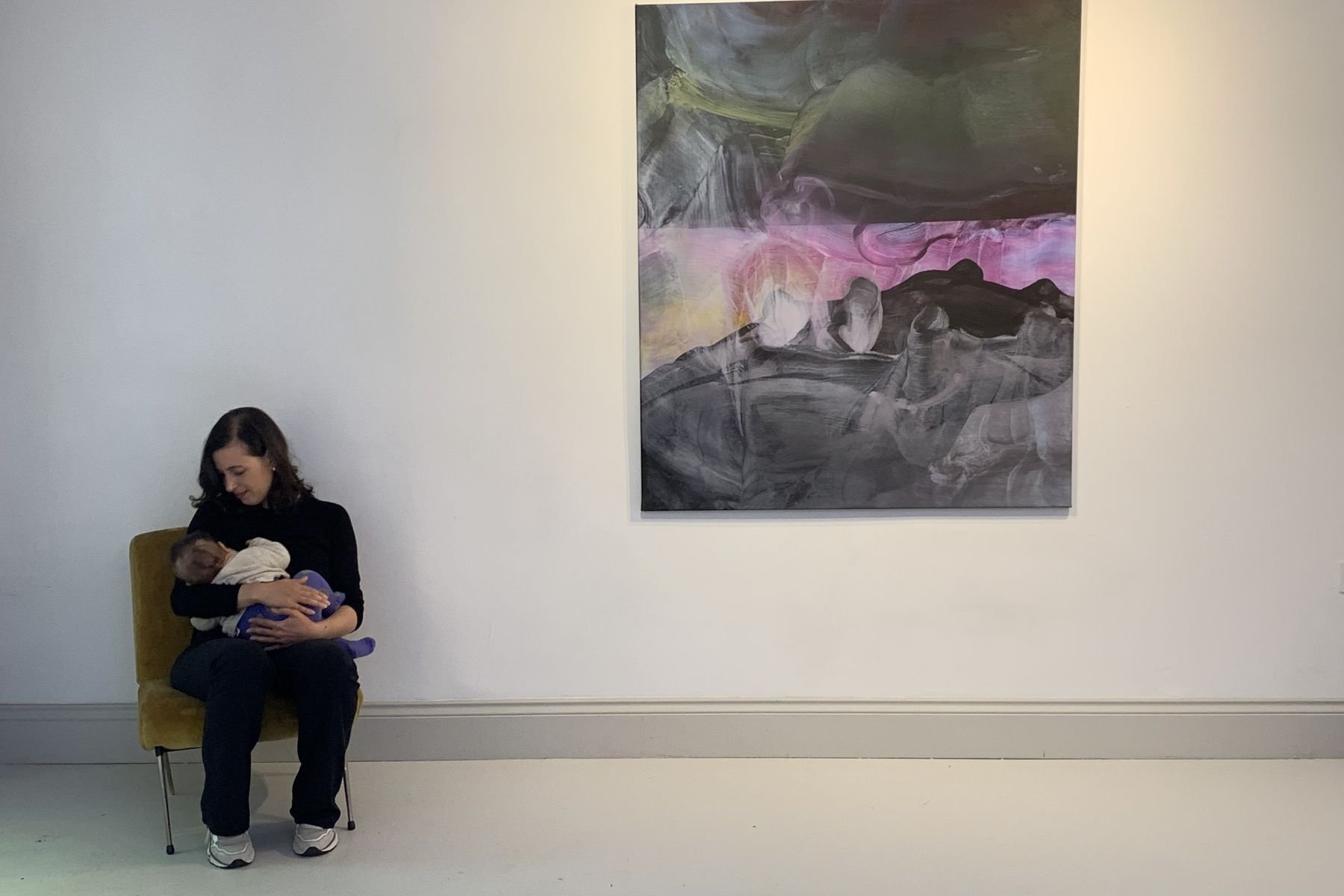
Joanna Jones’s let the bitter be bitter and the sweet be sweet until the bitter and the sweet become one (2018)
Photo: Tamara Al-Mashouk
Touring, parenthood and the art of making it work
Parents in the arts sector work in a system that fails to support them adequately. Here, producer and new mother Nora Laraki shares her experience of taking a baby on tour.
“We’re having a baby!” The whole company squeals as the parents-to-be soak up the cheers and congratulations. We’re in Australia, autumn 2023, gathered for a team dinner the night before a festival set-up. It’s the second intense year of touring for our mid-sized performance piece, and I’m deep in booking dates for 2024.
As lead producer, I’m responsible for travel, budgets, partners and making sure the show can happen wherever it goes. Looking back, these are my reflections as a producer figuring out how to make touring work for new parents.
The parents-to-be were an essential part of the team, their skills and presence woven into the fabric of the show. In performance art, people are rarely interchangeable – this was no exception. Both wanted to keep working and touring was a big part of their income, identities and career development.
But as their work takes them on the road for long stretches, the usual model of one parent staying home simply wasn’t possible. One would have been solo parenting, the other missing out on their baby.
And so, naturally, the idea formed: the baby would come on tour with us. None of us knew how that would work, but we were optimistic. How hard could it be to take a newborn on an international tour? The answer: challenging, but unexpectedly joyful.
Lack of best practice examples
Childbirth rarely goes to plan, so how do you plan for the unplannable? Over the next months, we had many conversations. At first, it was hard for the parents to know what they needed. How long a break after the birth? When would they feel ready for flights? What kind of accommodation would work? We spoke to other producers and artists and spent hours searching online for examples of how other touring companies had done it. It was surprisingly difficult to find practical information or examples of best practice that matched our situation.
At some point, we realised there wasn’t a handbook. To make it work, we had to come up with our own model. We began piecing together what might be possible, balancing everyone’s needs and responsibilities until a plan started to take shape.
Our starting point was that both parents and the baby would come on the road. But who would look after the baby? We floated plenty of ideas. I made clear babysitting during tech calls wasn’t going to be part of my producer role. Hiring local childcare in each city sounded possible, but the thought of a baby having to adapt to a new caregiver every week quickly ruled that out. A nanny joining the tour wasn’t feasible either; it was too expensive.
The financial reality made things harder. Freelancers and self-employed artists don’t qualify for Statutory Maternity Pay – only available to employees. Instead, they can apply for Maternity Allowance, a government payment of between £27 and £184, barely covering everyday costs. And there’s no Paternity Allowance for self-employed fathers, which makes it even harder.
UK policy differentiates between maternity and paternity, offering very different levels of support so making it hard for couples who want to share care – and even more so for queer families who don’t fit neatly in those categories. On top of that, UK childcare is largely privatised and among the most expensive in Europe. Full-time nursery care can easily swallow most of a parent’s income.
A rotating model
We landed on a rotating model: one parent worked onstage while the other focused on the baby. We brought in a substitute for each role to allow the non-working parent to travel with the company and focus on childcare. While one parent alternated in missing out on the performing fee, neither missed out on being with their baby. We made sure the family wasn’t out of pocket for extra flights or accommodation and both could keep working without a long break.
For this tour, we operated a performance fee model which meant artists’ fees were guaranteed and income predictable. We reworked the budget to build in a cushion for larger rooms, extra flights and family transport. The performance fee filled the gap left by the lack of parental support from the sector and government.
We were essentially subsidising ourselves to enable one parent to keep working while both could stay together as a family. It only worked because the lead artists were open, collaborative and willing to adjust the budget for everyone to continue touring.
Flexibility was vital
Alongside the financial model, we had to think about how a baby would affect the rhythm of a tightly planned touring schedule. My first instinct as producer was safety first. Our set ups were often chaotic, with ladders, rigging and fragile equipment, so the parents had to keep the baby out of the auditorium during get-ins and rehearsals.
Once on tour, flexibility was as important as clear boundaries. Regular breastfeeding breaks had to be scheduled with the parents working closely with the production team to make it possible. When rehearsals or show times couldn’t be adjusted, they found workarounds – like pumping. Having developed good practice on accommodating other access needs, we knew how to stay flexible and supportive, when to ease pressure and when to pull together to push through.
A year later, we can look back on an ongoing, successful tour in which we managed to fold parenthood into our model, stick to our commitments and keep the show on the road. There were hiccups and plenty of learning, but a baby added something grounding. It shifted the rhythm of touring life, bringing small moments of care and balance. Some of the team even followed the baby’s schedule: taking breaks for naps and meals helped everyone recharge during intense weeks of back-to-back touring.
So, what did we learn?
Touring with a baby is not a showstopper, but it does require a flexibility, backup plans (A–D) and boundaries. The bigger issue is the assumption in the sector that artists are child-free by default. Childcare is rarely budgeted, parental leave barely acknowledged. For many artist-parents, these conditions force a career break or an exit altogether.
Writing this now on maternity leave with a four-month-old of my own, I see the gaps more clearly. I have a job to return to but, across the creative industries, many parents have to step back or leave after having children.
In the arts, work is already precarious, and the impact of balancing care and career is magnified. The hours, travel and instability rarely fit with caring responsibilities – it doesn’t take much to find yourself on the sidelines.
In the end, even with the adaptations we made, this was just one project. Parents are still working within a system that doesn’t support them. What’s needed is structural change. Equal and fair parental pay for freelancers so mothers aren’t pushed out of work; genuinely affordable childcare; and the ability to include childcare as an access cost in funding applications. Only then will artists be able to work without having to choose between their practice and their families.

Join the Discussion
You must be logged in to post a comment.