
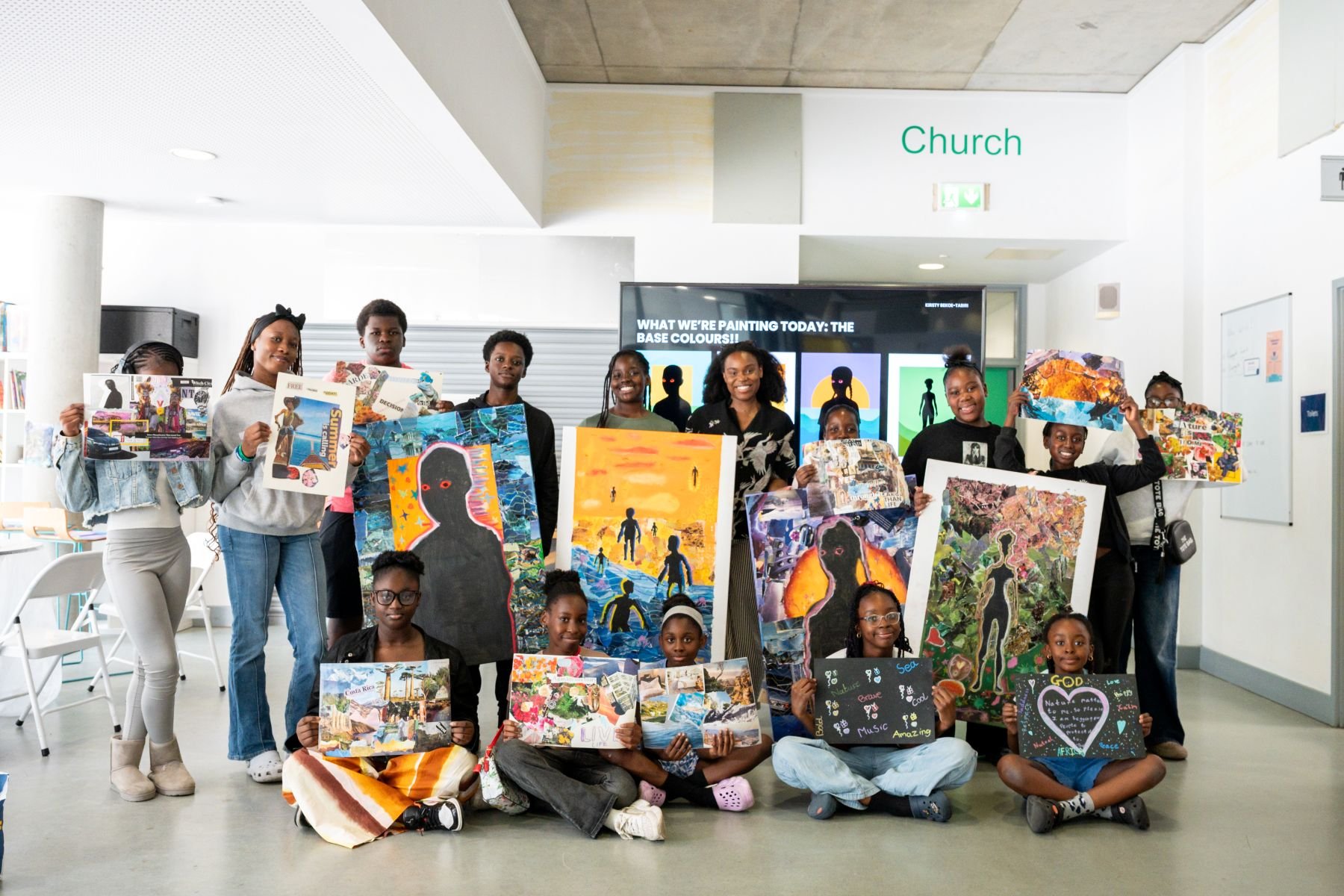
The Creative Communities Network brings together local practitioners and citizens through co-created cultural activities
Photo: Jimmy Lee
Reimagining cultural life as living networks
The measurement systems governing cultural life were never neutral; they arose from policy shifts that defined whose knowledge and what value count. David Reece and Sarah Wickens explore what becomes possible when we move beyond counting and recognise culture as collective intelligence emerging through relationship.
The cultural sector didn’t set out to become obsessed with measurement but, over the past forty years, measurement has hardened as the primary logic. Beginning in the 1980s, cultural policy in the UK shifted from subsidy-as-right to subsidy-as-investment. The National Lottery in the 1990s accelerated this shift as with new funds came new accountability frameworks, and impact became a currency to be demonstrated.
What followed was a layering of systems: segmentation models, KPIs, dashboards and outcome frameworks – all designed to make cultural life legible to funders and policymakers. Each step made sense at the time. Data offered clarity, comparability and justification but, over time, these systems bent practice toward what could be counted, pushing relationship, memory, trust and the lived texture of culture to the background.
The result is now a fundamental mismatch where institutions have learned to count what they do rather than tend the relationships that sustain them.
The new cultural reality
The current climate makes this mismatch impossible to ignore, with a complex and often contradictory cultural landscape that defies simple narratives. On the one hand, DCMS sponsored museums and galleries remain 14% below 2019 visit levels, and visits to the 400 Association of Leading Visitor Attractions sites are still 8.8% down on 2019.
While on the other hand, the West End tells a different story with over 17.1 million theatregoers attending shows in 2024, an 11% increase on pre-pandemic levels, and outperforming the Premier League by 2.5 million attendees. Regional theatres report a 4% occupancy increase since 2019, and live music is booming with 23.5 million music tourists in 2024 (up 23% on 2023).
Competition for entertainment and time is fierce. So, it’s no wonder that entertainment spend has consistently risen month on month with 42 of the last 48 months showing an increase on previous years, proving to be the most consistently resilient sector in the economy.
But what do these statistics really tell us? The West End’s success reflects international tourism recovery and pent-up demand for shared experience, but also signals how cultural consumption has become more selective and event driven. The music tourism boom captures something new entirely: hybrid experiences that blend culture, travel and social media in ways that don’t map onto traditional participation categories. And according to DCMS’s participation survey, 91% of UK adults engage with arts activities, but increasingly outside institutional frameworks entirely.
Simultaneously, the creator economy has reconfigured cultural production at unprecedented pace. More than eight million new creators in the UK have joined the economy since 2020 taking the total to 16.5 million (approximately 25% of the population), contributing to the global creator market now worth an estimated $250 billion and expected to double by 2027.
The challenge for traditional cultural infrastructure is whether any of this is complementing or replacing it, which begs the question as to how cultural institutions will adapt to these new realities as opposed to measuring success through frameworks designed for a world that no longer exists.
Old frameworks, new realities
Current measurement systems don’t just miss complexity, they can also actively distort it, creating two critical failures that philosopher Bruno Latour would call a classic category error: treating dynamic webs of relationship as collections of static objects to be counted.
First, misdiagnosis. While DCMS data shows 43% average physical engagement with museums nationally, it also reports a high of 56% in London and just 37% in Barking & Dagenham. This statistical gap leads to deficit narratives where the assumption is that certain communities ‘lack culture’, while overlooking the informal cultural networks that already exist.
Likewise, when Muslim adults show 31% museum engagement and Sikh adults show 29%, this becomes more a reflection of measurement systems that only capture certain cultural traditions than an indication of cultural engagement.
Second, extraction. Conventional measurement operates as one-way data extraction: communities provide insights that are reassembled centrally without reciprocity or power sharing. This extractive logic treats knowledge as a resource to be mined rather than relationship to be nurtured.
None of this is technical failure, it’s political. These systems emerged from decades of policy shifts that gradually reshaped how cultural value is understood and demonstrated, with effects that now privilege certain forms of knowledge over others. What gets measured is legitimised; what remains invisible loses resources. The result is funding and policy that strengthens certain nodes while weakening the distributed networks where most cultural life takes place.
Relationship as method
The alternative begins with what academic Donna Haraway would call ‘staying with the trouble’, working with complexity rather than trying to reduce it to manageable metrics. This means treating relationship as foundational method: ongoing, reciprocal connections rooted in place, carrying tacit knowledge and collective memory.
To return to Latour’s work on actor-network theory, instead of treating cultural life as a collection of discrete objects (visits, audiences, outputs), we should look at it as a web of relationships where meaning and capacity emerge through connection. Cultural institutions aren’t separate from their communities, they’re already part of networks that include people, histories, places and practices.
In practical terms, this means shifting from measuring cultural participation as individual consumer behaviour to understanding culture as collective intelligence that emerges through sustained interaction. Rather than asking about how many people engaged with culture, instead asking how relationships are strengthened through cultural engagement and what became possible that wasn’t before.
None of this is about abandoning evidence and data, but about expanding what counts as evidence to include the kinds of knowledge that can only emerge through relationship over time. The goal is reform, not revolution – working within existing systems while broadening their scope.
Continues…

A Citizens’ Panel exploring the future of the Galleon Arts Centre in Imagine Galleon Together. Photo: Jimmy Lee
The power of citizens
Against this backdrop, new approaches are emerging from multiple directions: financial pressures on institutions, the growth of deliberative democracy movements, and a new generation of cultural leaders questioning traditional governance models. A handful of cultural institutions are already looking at alternative forms of engagement, moving from consultation to co-creation, focusing on relationship rather than measurement.
- Creative Barking & Dagenham: Citizens as co-creators
In a borough where national data suggests cultural ‘deficit’, Creative Barking & Dagenham established a Citizens’ Panel for the Galleon Arts Centre* that inverts conventional engagement logic. Rather than asking residents to respond to predetermined programming, the panel positions citizens as equal partners in shaping the centre’s purpose and practice.
The transformation is methodological: asking a simple question about what we’re building together. This shift from consultation to co-creation reveals capacity that survey data cannot capture: residents’ deep knowledge of place, their existing cultural networks, their aspirations for collective creativity. The panel doesn’t just provide input; it generates new forms of cultural agency that extend far beyond the centre itself.
- Birmingham Museums: From non-engagement to advocacy
Birmingham Museums’ Citizens’ Jury brought together 26 jurors for 30+ hours of deliberation on the future of the city’s museum services. These were people who would register as ‘non-engaged’ in conventional participation data, but through sustained collective inquiry, they didn’t just offer opinions; they developed ownership.
The jury’s recommendations reframed museum purpose and created long-term advocates. More importantly, the deliberative process showed that transformation happens through relationship, not information transfer. Jurors weren’t given content about what to think, they were given conditions within which to think collectively, generating civic pride and legitimacy that no survey could produce.
- National Gallery: Scale and intimacy
The latest organisation to join the growing list of those embracing the power of citizens is the National Gallery (NG), announcing its NG Citizens as part of a five-year partnership with people from all four nations of the UK to shape the future of the gallery.
NG Citizens represents the challenge of maintaining relational intimacy while working at national scale, and whether democratic participation can be substantive rather than symbolic when embedded in major national institutions.
The press release promises a way of embedding the public voice throughout the gallery’s ongoing decision-making processes, but the risk remains that participation becomes performative – same power structures with different names. Time will tell, but the key test is whether citizens gain genuine decision-making authority or remain in advisory roles.
Different data, different realities
These approaches produce qualitatively different knowledge than statistical surveys, and work together to complement one another. Where participation data reveals demographics and attendance figures, relational methods produce insight into trust dynamics, the durability of partnerships, shifts in narrative and identity, and the emergence of new forms of collective capacity.
Practical examples of this approach might include relational mapping that tracks connection patterns over time; participant narratives that show transformation processes; learning logs that document emergent insights; long-horizon visions that guide institutional responsiveness; and accountability reviews that assess reciprocity. These practices are what Haraway would call ‘response-ability’ – the cultivation of capacity to respond appropriately to what arises, even when it exceeds existing categories.
The transformation required
Switching focus from measurement to relationship requires three fundamental shifts that operate across funding, governance and evaluation.
- From independence to entanglement
This means recognising institutions are embedded networks of people, histories, cultures. Rather than treating context as external environment, institutions become accountable to the webs of relationship that sustain them. Practically, this might mean funding that strengthens networks rather than individual organisations; shared governance structures that distribute decision-making; resource-sharing arrangements that build collective capacity.
- From extraction to regeneration
Instead of drawing value from communities to fuel institutional agendas, investment flows in ways that generate more capacity locally. This means funding that follows relationship rather than predetermined categories; governance that embeds community power rather than consultation; evaluation frameworks that assess the strength of the networks rather than organisational activity.
- From prediction to responsiveness
Rather than controlling outcomes through tighter measurement, institutions build capacity to adapt to what emerges, even when unexpected. This means designing systems for responsiveness rather than compliance; measuring adaptation rather than adherence; celebrating productive surprise rather than managing it away.
The choice before us
In ten years, will the cultural sector still be organised around the fiction of independent organisations serving external audiences, measuring success through statistical proxies that systematically exclude whole ways of being and knowing? Or will we have learned to work as elements within living networks, supporting the flow of creative intelligence through relationships of reciprocity and mutual aid?
This isn’t just a choice about cultural policy; it’s about what kind of world we want to inhabit. The measurement systems governing cultural life didn’t emerge neutrally, they developed through policy shifts that reshaped how cultural value is defined and by whom. Systems organised around extraction and control produce alienation, competition and scarcity. Systems organised around relationship and reciprocity generate belonging, collaboration and abundance.
The Taking Part data shows us one version of England’s cultural life: measurable, manageable, controllable. But in places like Barking & Dagenham, communities are already demonstrating alternatives, creating culture through relationship, generating meaning through collective action, sustaining practices that exceed any survey’s capacity to capture.
What is most alive will always exceed our ability to contain it in statistics. The choice is whether we try to force life into categories or learn to design systems that support the development of what’s already there.
This transformation is already emerging through existing networks and relationships. Organisations like Citizens in Power, founded in 2022 by arts leaders, are bringing together citizen-led decision making alongside institutions willing to experiment with new approaches. The question isn’t who leads change from above, but how to nurture the conditions within current relationships for new approaches to surface and spread.
Case study: Creative Barking & Dagenham
Imagine Galleon Together
When the Galleon Arts Centre needed a new strategic direction in 2025, Creative Barking & Dagenham worked with Citizens in Power to establish a Citizens’ Panel to shape its future through genuine decision-making authority.
The Citizens’ Panel met for two intensive days in June 2025, working with the question: ‘What would Galleon Arts Centre be like if it was a creative and inclusive space that could afford to stay open?’
Day One focused on building shared understanding. Citizens explored the centre’s history, the national cultural funding landscape, demographic data for their area, and case studies of cultural spaces nationwide. Facilitators supported participants to share lived experiences and develop collective vision, not predetermined responses.
Day Two turned to practical decision-making. Citizens heard evidence on the local creative landscape, considered operational budgets and financial realities, then moved into structured deliberation to identify core purposes, draft strategic priorities, and develop guiding principles.
The process used deliberative methods throughout: structured small-group discussions, collective review exercises, co-drafting, ensuring all voices were heard and participants could weigh evidence together. Decisions emerged through identifying principles the group as a whole could endorse as opposed to majority vote.
The panel’s final principles included protecting Galleon as a multi-arts space, celebrating ethnic diversity, ensuring accessibility and affordability, and maintaining citizen-led collaborative decision-making. Their purposes ranged from building community as social space to supporting local artists’ skills and networks.
In the words of the panel: “This area needs to be a place where the creative aspirations of working-class children are fostered and grown.” In addition: “It needs to be a co-created space, not just a hireable venue.”
The Creative Communities Network
The Creative Communities Network operates alongside this democratic governance structure, bringing together local practitioners and citizens through co-created cultural activities. Over the summer, supported through Arts Council England’s Creative People and Places funding, artist Kirsty Bekoe-Tabiri was commissioned to lead collaborative workshops with grassroots youth groups, combining thinking, making and storytelling through poetry, collage, sculpture and co-created painting.
The group experimented with layering personal experiences, collective vision, and shared concerns about the future, building toward a collaborative body of work for public display.
Kirsty then ran sessions with different local people, sharing the process with other artists and building a larger network for ideas, work and potential future collaboration, demonstrating how relational approaches expand capacity rather than focusing on finite outputs.
Data is helpful to see who is and isn’t engaged with decision-making processes and networks, but not as judgment about people being ‘low engaged audiences’. Instead, it shows how to strengthen relationships and expand democratic participation in shaping cultural life.
Join the Discussion
You must be logged in to post a comment.