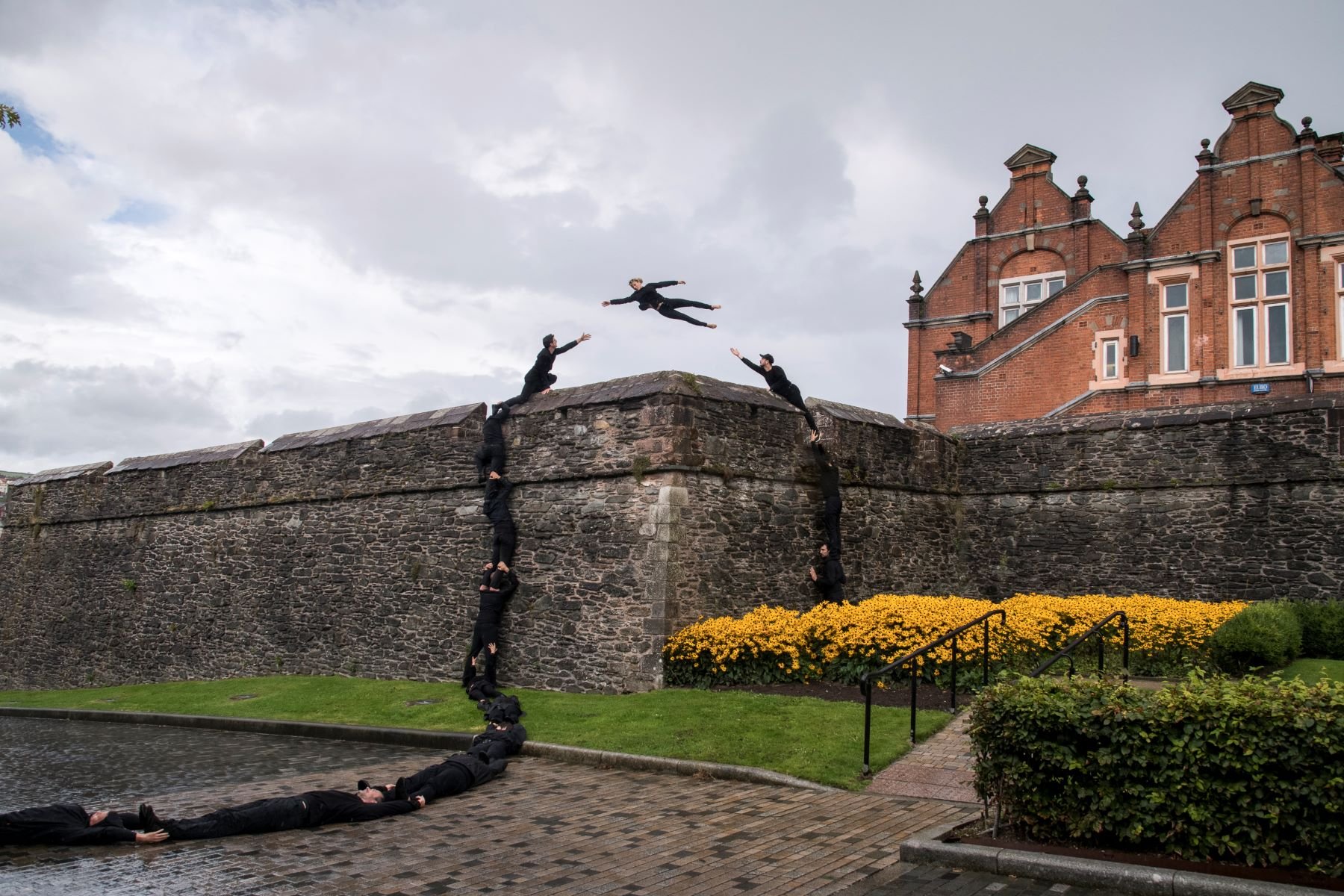
France's Compagnie XY performing Les Voyages, Derry-Londonderry
Photo: Samuel Buton
Northern Ireland’s arts sector worse off now than before peace agreement
In 2000, political leaders described the arts as essential to building a shared future. Why, then, is Northern Ireland’s arts sector the lowest funded in 25 years? asks Cian Smyth.
It’s a quarter of a century since Northern Ireland’s first devolved government was established after the Belfast Good Friday Agreement. Then the arts were deemed as central to building peace.
Back in 1999/2000, exchequer funding for the Arts Council of Northern Ireland (ACNI) was £7.5m (£14m today). The political discourse of the time was anchored in the phrase – ‘Building A Shared Future’ and many government strategies and policies led with it.
A rush of ambition and promise was felt on the streets.
Significant reductions
A quarter of a century later, funding for the arts through ACNI was about £9.5m. This represents a cut of 30% over that period – and a drop of 53% from a peak investment of £14m (£20.5m today) in 2011/12.
That peak followed a capital investment programme after Belfast’s failed bid to secure European Capital of Culture status in 2008, due to a lack of arts infrastructure. It led to the renovation of public squares as event spaces and the building of new arts centres like The MAC. The logic? There is no shared society if you can’t attract audiences from across diverse communities into shared cultural spaces at its centre.
The per capita spend on the arts in Northern Ireland was £5.53 in 2016/17, the earliest record. Across the border, in the Republic of Ireland, per capita spend on the arts was £12.85 and, as of 2023/24, it is now £22.27. In 2024/25 NI’s per capita spend is £5.03, less than it was ten years ago.
If the arts are so central to building a shared future, it is shocking that the Republic receives 2-5 times the investment in its arts sector while Northern Ireland, recovering from violent political conflict, has seen such significant reductions.
Politically motivated?
If the arts are essential to building a shared future, when did the political leadership at home and across these islands, all signatories to our peace agreement, decide they were no longer valuable in achieving that goal?
The last ACNI General Population Survey in 2023 found that 79% agreed ‘it is right that there should be public investment in arts and cultural organisations’. The government itself reported that 90% ‘of the population of Northern Ireland had engaged in culture, arts, heritage and sport in 2023/24’. If disinvesting in the arts is not a publicly motivated decision, it must be politically motivated.
Has our conflict now bedded into our government’s systemic framework? Has equality legislation been instrumentalised as a political tool for cultural separatism? Are we no longer building a shared society?
Letter of Expectations
For ten of the past 25 years, Northern Ireland’s Legislative Assembly has either been suspended or collapsed. The Department of Culture, Arts and Leisure was abolished. Today, the arts branch is a tiny part of the Department for Communities, responsible for the Housing Executive and Social Welfare.
Its minister, Gordon Lyons, has resisted approving the 2025/26 exchequer budget to ACNI until “monitoring arrangements” are established. This was outlined in his Letter of Expectations to ACNI in February which states that the budget will not be agreed until ACNI’s new strategy for the arts is reviewed and re-aligned with “my strategic priorities”.
The letter also stresses the importance of an Arts Council focus on heritage and traditions. There is a lot in the letter about access and inclusion, interpreted through the minister’s vision for more representation of heritage and tradition in the arts. This raises complex issues for a divided society.
What is the real ask here? And is it politically motivated?
The minister’s letter continues: “To ensure maximum accessibility and inclusion, I expect the Council in the terms and conditions of its funding programmes to ensure that any activity disrespectful of any tradition, in locations or by groups receiving Council funding, results in specific and substantive action as regard funding.”
Is he asking the Arts Council not to fund certain artists and organisations? It’s a puzzling statement, because if you apply it for any tradition, it is almost impossible to not offend one or more other traditions.
He concludes: ‘It is therefore important that the Council ensures that its public statements align with lines taken by me and my Department and do not go beyond them.” He refers to the Council, appropriately, as an arm’s-length body but doesn’t seem to understand the meaning of the term.
As a sector, we need to pay close attention to what is happening in Northern Ireland. Our sector is being decimated in a long-term, intentional way by our political establishment.
Why is this relevant?
If the arts don’t work for peace building here, it raises questions about the role the arts play overcoming conflict or social division worldwide. It also suggests societies like ours could be political testing grounds for challenging public arts strategies everywhere.
Governments are less motivated to invest in the arts. Why support something that offers the public opportunities for critical analysis or diverse points of view when the political system prefers stories following rigid ideological lines?
We need to pressure our political establishment about why the arts matter to society. For too long we assume it is a given, or fear funding repercussions. We need to tackle politicians directly. Because ensuring the arts succeed in helping Northern Ireland build a new future proves the case that art remains central to society anywhere.
Join the Discussion
You must be logged in to post a comment.