
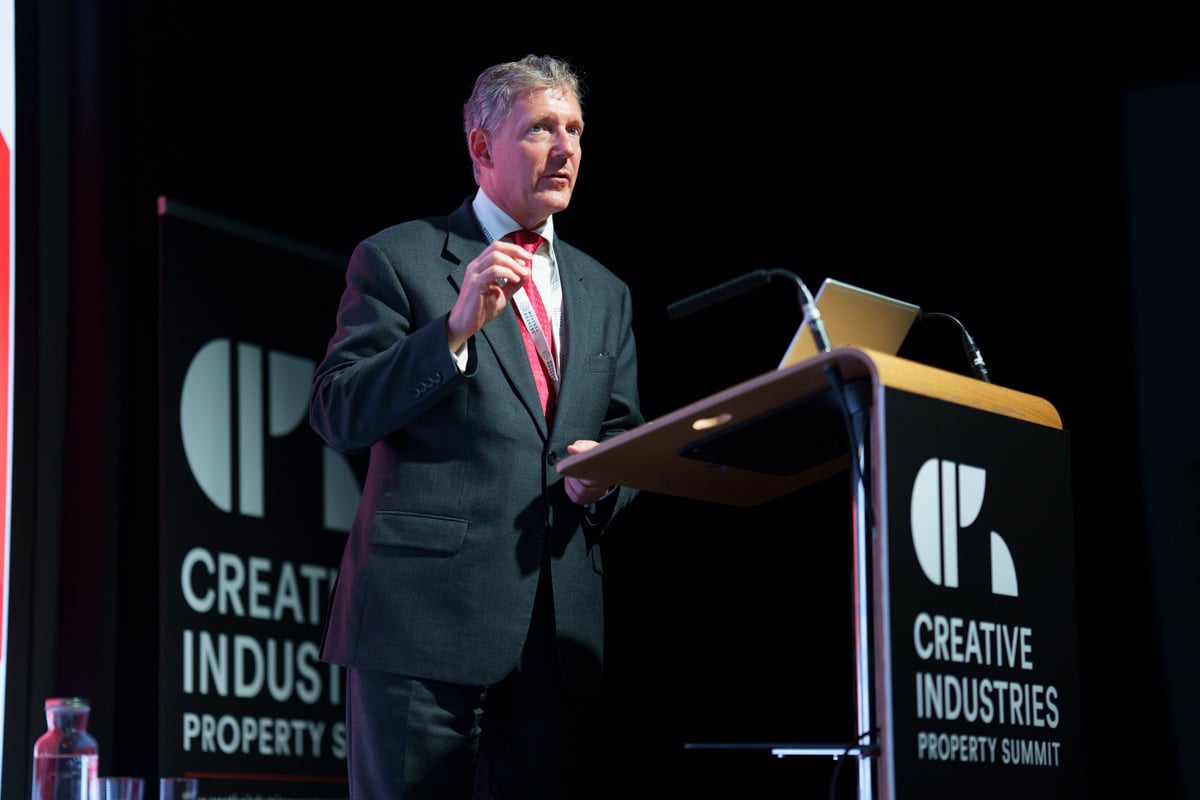
Professor Christopher Smith says the AHRC will invest £100m in new Creative Industries Clusters over this Spending Review period
Photo: Christopher Andreou Photography
Industrial strategy, property and the creative industries
Addressing the Creative Industries Propery Summit in London last week, Professor Christopher Smith, executive chair of the Arts and Humanities Research Council, called on the two sectors to work in partnership to build a creative future for the UK.
The creative industries are a dynamo for growth in our economy and across the UK’s nations and regions. Wherever you look, the UK is number one, two or three in the world – but it is an increasingly competitive world and one that is moving astonishingly fast.
The fact that the government’s industrial strategy included creative industries was not a given, and it took a lot of hard work and data and argument to put us alongside high value manufacturing and life sciences and the rest.
Why was it such a stretch? I think it’s partly because the sector is quite large and sprawling. What have architecture and theatre, or IT and craft have in common? Other sectors seem more coherent – when we say life sciences we conjure up pretty standard images – person with test tube in lab produces drug which makes me feel better – but that requires an equally broad range of skills to build the required ecosystem.
What’s the purpose?
Life science is in some way about our health – what do the creative industries point towards? I think the answer is the other side of our health – not our physical health but our mental and emotional health.
93% of 16-18 year olds say studying a creative subject impacts positively on their mental health and wellbeing. £1 spent on early care and education has been calculated to save up to £13 in future costs. Participatory arts activities with children improve their cognitive, linguistic, social and emotional development and enhance school readiness. After engaging with the arts of 79% of people in deprived communities in London ate more healthily, 77% engaged in more physical activity and 82% enjoyed greater wellbeing.
I could go on. Just imagine your life without film, TV, music, games, books and magazines – but also advertising and marketing, safe and well designed products for our material and online life, good architecture in houses and hospitals, schools and supermarkets. No drug will fix a world without all that.
Conditions for growth
An industrial strategy has to pick and choose and prioritise but the government is right to include creative industries because it affects so many people positively and because it has enormous growth potential. And if we are to get this country moving again, we can’t just talk about economic growth, we have to talk about sustainable regenerative growth that lifts us all across the UK.
In the plan we developed for creative industries our job was to ensure we created the conditions in which this beneficial impact and economic growth can take place.
There are four key components:
- Ease, speed and long-term stability
We have to make it more possible for businesses to grow. That means more investment, and better investment. Creative industries is largely driven by SMEs that have some of the largest challenges in accessing finance. We have to unlock the opportunities of the money in our country to support the country’s ideas, not lock our money up in cost and risk aversion.
That means we need to manage IP, we need to build digitally-aware skills, and we need to address planning reform, R&D tax credits and business rates for small creative businesses.
- Supporting our frontier industries
Key to this is driving our strongest sectors hardest. The measures proposed are intended particularly to target high-growth sub‑sectors, as well as unlocking the emerging, disruptive growth potential of createch and its spillover benefits.
- Supporting the UK’s city regions and clusters
Unleashing the full potential of city regions and clusters across the UK is a core objective of the Industrial Strategy. That’s why the AHRC will invest £100m in new Creative Industries Clusters over this Spending Review period.
- Creating an enduring partnership with business
We expect the sector to grow over the next decade, in which – based on past trends – annual GVA could increase by £40 billion in real terms and over 400,000 additional jobs could be created by 2035. This plan is a first step – but it will require partnership.
Partners deeply rooted in space
Property is a key partner, which is why the Creative Industries Property Summit matters. Long term stability needs to be underpinned by the right conditions; spaces to work, transport that functions, facilities that allow scale up, long term investment.
Interestingly, the GVA of the property industry and its job share is very similar to that of creative industries – 5% GVA, 1 in 13 jobs – and again everything from builders to high end executives. We are quite similar and I believe we share in an aspiration for well-being.
No-one builds homes for unhappiness. No one builds for misery. No property survives deprivation and poor physical and mental health. So we are in the same game – human hope and flourishing. And we are all deeply rooted in place. That is why so many policy makers are interested – because everyone who works in local government knows that this nexus is important.
So it’s my hope our industries will learn from each other and come back to the concrete steps we need to take to build a creative future together.
Join the Discussion
You must be logged in to post a comment.