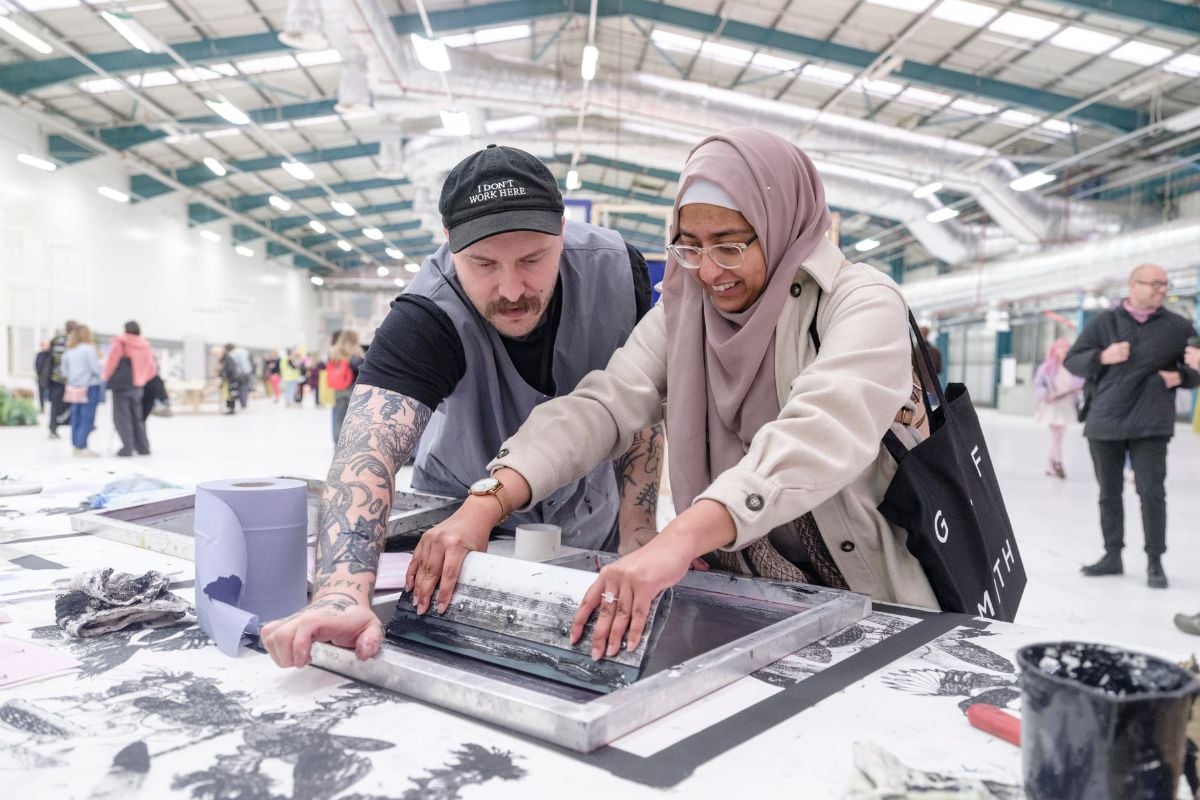
A 'print your own clothing' workshop at the 2024 Dundee Design Festival, which was supported by Creative Scotland
Photo: Grant Anderson
Reviewing Creative Scotland: No easy feat
Former director of creative industries at Creative Scotland, Clive Gillman, believes there’s much to commend about a review into the funding body, but suggests there was always a conundrum at the heart of the task.
Who leads a government review, why is it conducted, and critically, what is the brief? In terms of the recently published review into Creative Scotland, each of these has, at some point, sat within a mist of uncertainty.
In some ways, Creative Scotland – like any reasonable organisation – has been in a process of almost constant review since its inception in 2010. Most recently, the Funding Review of 2020 and the implementation of a new Strategic Framework from 2021 have been fundamental, leading to a significant uplift in support for Scotland’s cultural infrastructure via the 2025-28 Multi-Year Funding Programme.
So why was the latest independent review necessary? The Scottish government has made its funding commitments clear up until 2028, with that money channelled by Creative Scotland to 251 organisations. How might this review add to (or detract from) the momentum that Scotland currently has? It was initiated by Cabinet Secretary Angus Robertson in September 2024, to ensure Creative Scotland’s ‘operations and structure are optimal to the needs of the culture sector’.
Leaving aside the possibility there is no commonly held understanding of what constitutes the ‘culture sector’ in Scotland, there is a conundrum at the heart of the task: who is the main beneficiary of Creative Scotland and this review? Artists… or some broader definition of public value? The review goes some way towards acknowledging this but chooses not to resolve it.
Despite these concerns, the remit was restated in May 2025 with a further 17 bullet points covering remit, fundamental principles, operational processes, and a few imponderables like ‘the wants of the whole sector’. It leaves the boundaries of its resulting recommendations fuzzy.
A complex area of public policy
There’s much to commend in the review but it falls into the inevitable trap of such processes. It presents commentary from consultations with little or no examination or challenge. It reads as if a final stage is missing. As a result, there is a danger that selected statements are given power within the document, without any critical response.
Solely relying on ‘here’s what some people told me’ is not sufficient in such a complex area of public policy. It is likely that many of those who have contributed to the review will be principally occupied by how their work can be better supported in the future. Inevitably, this goes back to money and the simple fact there’s not enough. Meanwhile, whenever ‘quality’ is mentioned, there is a sinister subtext: that funding might be going to someone or something less deserving.
There are notable gaps in the evidence base for the review. For example, the chair has not cited the 2020 Funding Review mentioned above, the largest and most detailed consultation about funding that the organisation has ever undertaken and on which many recent strategic decisions have been based. This gap is evident in many of the more critical comments about the development of strategy over the recent period.
The review also focuses strongly on the Fair Work First agenda, whilst largely ignoring many of the other requirements of the wider statutory landscape that determine the actions of the organisation, such as the Equality Act or climate legislation. Perhaps this ‘review of the review’ is the role of the Scottish government now, but it would be helpful if this work was done before entering the public domain.
A successful sector relies on more than Creative Scotland
There are also traps set by overly intensive expectations, like the recommendation that Creative Scotland should consider “the options for reintroducing relationship-based roles” despite the review also detailing a perception that the “jam was being spread too thinly”. It will be interesting to see who is tasked with unpicking that challenge.
Overall, it’s great to have this work completed so that the organisation can move on out from under the shadow such a process creates. For my part, I felt very positive about the clearest statements, like the finding that the “success of the sector in Scotland is not Creative Scotland’s alone to pursue” and the call for the Scottish government to consider whether Creative Scotland should become a statutory partner or consultee in planning legislation – something that would be truly empowering for culture in Scotland.
Nonetheless, I can’t help wishing for a more carefully crafted insight into the complexities inherent in building a creative Scotland. Maybe that is still to come.
Join the Discussion
You must be logged in to post a comment.