

Macbeth at the Savonlinna Opera Festival, Finland 2007
Photo: Jaakko H/Creative Commons
Book review: Otherness and identity at the heart of opera
In this review of Alexandra Wilson’s Someone Else’s Music: Opera and the British*, John Birchall examines the historical view of opera as elitist.
In his 1827 Life of Rossini Stendhal tells us, “I have met with a score of young Neapolitans who could compose a song as unconcernedly as young men in London write letters, or young men in Paris pen sets of verses.” For him, opera was quintessentially Italian. And the French loved it.
Already, before Verdi and Wagner became sources of national pride, there was tension between celebrating opera’s ‘otherness’ and adjusting it to local tastes. In Donizetti’s La Fille du Regiment, Marie, a canteen girl with the French army on the verge of conquering Tyrol, falls for Tyrolean Tonio. He loves Marie in return.
When the opera was staged in Italy in 1840, the action had to be moved to Switzerland so Tonio did not lose his ‘good guy’ status: audiences in Italy, then under the Austrian empire, may have disliked a Tyrolean.
When it was performed nearly two centuries later, in Paris in 2024, the Tyrolean was played by black American Lawrence Brownlee, while light-hearted patriotism enlivened the chorus Salut à la France. A cut-out Coq was wheeled onstage and the audience adored the celebration of Frenchness: another example of the creative tension between otherness and identity at the heart of opera.
In her book Alexandra Wilson shows how the perceived foreignness of opera has been a central plank of opera’s enemies in Britain. Supporters responded by promoting works written by British composers, or sung in English, or by training and supporting British singers.
The Elitism Myth
The other main plank of opera’s enemies in Britain is class, encapsulated in the title of Professor Wilson’s first chapter, The Elitism Myth. The book goes through the decades of the 20th and 21st centuries, examining attitudes to opera in Britain, citing numerous journalists and decision makers from comfortable backgrounds who reasoned it was not right to impose opera on the underprivileged, or on taxpayers.
The book also includes examples of people from poor backgrounds falling in love with opera, benefiting from it significantly, and seeking to bring it to others. Particular attention is given to Lilian Baylis, educator and founder of Sadler’s Wells and the Old Vic in the 1920s, though there are more recent success stories.
The arguments included both for and against opera in Britain do not add up to a coherent thesis but change decade by decade. Objections are a smorgasbord of stereotypes. Following widespread popular interest in opera during the 1920s, there was turn away during the 1930s with opera being viewed as for the wealthy.
Then during the war many soldiers heard opera and learned to love it. And during the post-war period, an understanding developed that subsidy was necessary to cultivate opera of a high standard, both as a public good and as a signal of Britain’s place in the world. Covent Garden became a permanent home for opera which sometimes aimed at international quality, and opera thrived elsewhere – both at the English National Opera and outside London.
For various reasons, some of which can be laid at the door of people in the opera world, this view came under pressure again. The latest thinking is that opera must be ‘decolonised’, a set of ideas which, although not without value, has fallen out of its modest fashion in the American academy. Anyone interested in opera or in arts decision-making will find the book’s overview of the themes and arguments in Britain illuminating.
Continues…
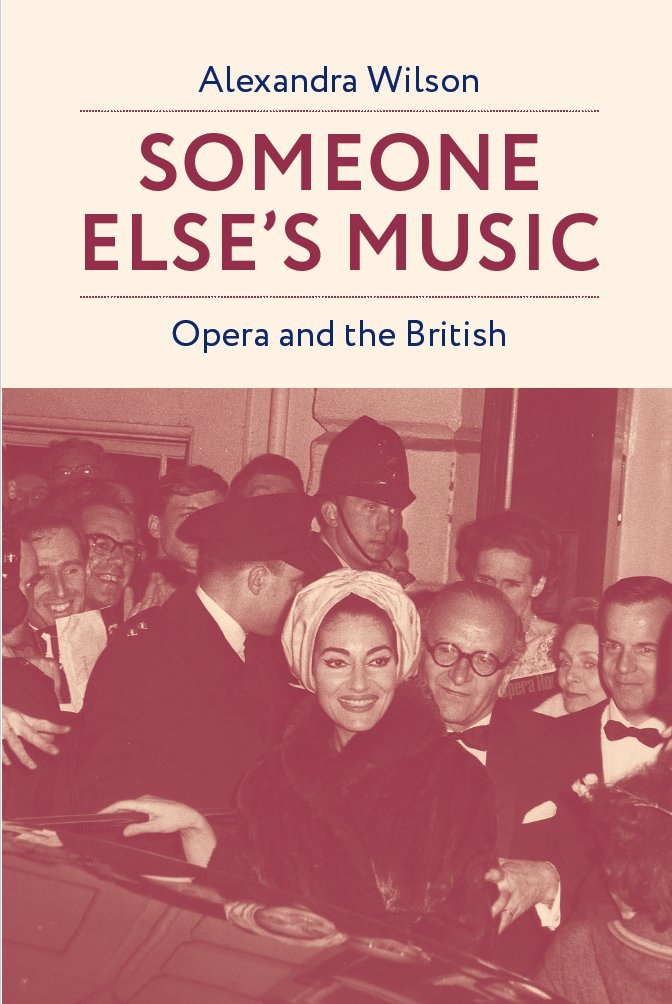
Cover of Alexandra Wilson’s Someone Else’s Music: Opera and the British published by OUP
Positive and tolerant identities
In conclusion, the author takes a bleak view of the future of opera in Britain, as recent policy has been hostile. However, one lesson she draws is that attitudes are constantly in flux. The old elitism trope has changed its meaning so much that, by our current century, people from poor backgrounds who fork out for opera tickets rather than expensive pop concerts are deemed elite – not because they wear tiaras (they don’t), but because they like opera. The elitist criticism of opera which Wilson objects to so strongly has been weakened by circularity.
New generations want something different from their parents. Young people of nominally Christian and Muslim backgrounds are turning to more traditional interpretations of their religions in surprising numbers. For others, it is the arts which offer that ‘something different’.
In a US election speech last June, Ugandan-born Muslim mayoral candidate Zohran Mamdani, who is shaking up the Democrats, remarked: “But this is New York, where the work never ends… And world-class musicians tuned instruments as we passed Lincoln Square.” While President Trump is unhelpful to the arts, culture is important to emergent parts of a revitalised left which care about quality of life.
Regular opera goers will have noticed many ethnic minority singers are appearing on opera stages. Some have become stars at the highest international level, such as the American Latina, Nadine Sierra and the South African, Pretty Yende: a source of inspiration.
Arts Council England may try to kill off British opera yet, as the world becomes more unstable, the demand for opera is likely to grow in spite of high costs. That’s partly because it is aspirational, partly because it’s an art form enthralling like no other, and partly because – among those who care about it – it fosters positive and tolerant identities and opportunities which unite us more than they divide.
*Alexandra Wilson’s Someone Else’s Music: Opera and the British will be published by Oxford: OUP in October 2025.
Join the Discussion
You must be logged in to post a comment.